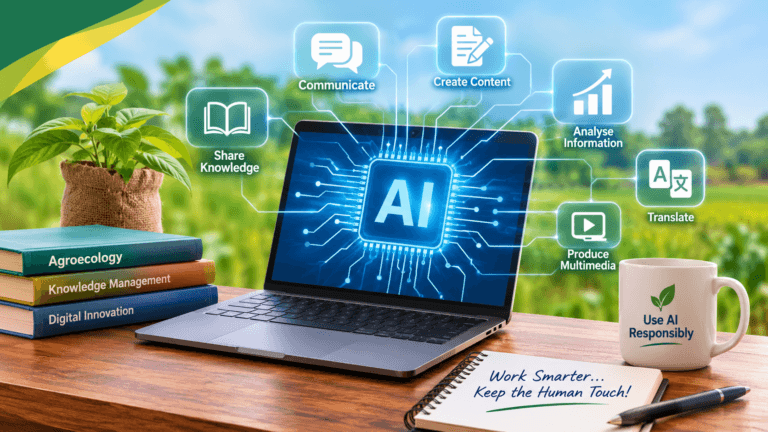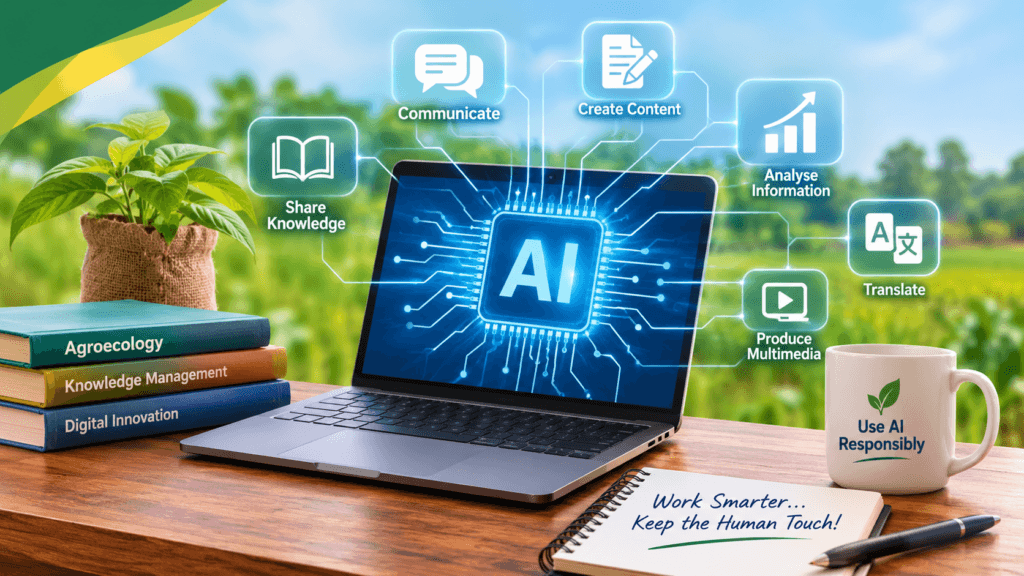
Artificial Intelligence (AI) is increasingly becoming part of how we work, communicate, learn and share information. From drafting emails and developing communication materials to analysing information, translating content and summarising lengthy reports, AI tools are creating new opportunities to make everyday tasks easier and more efficient.
For communication professionals, AI can support content development, brainstorming, editing, graphic design and social media planning. In knowledge management, it can help organise information, summarise documents, support research and make knowledge easier to access and share.
The opportunities go beyond communication. In agriculture, AI can support farmers and extension workers with access to information, weather-related insights, crop monitoring, research and decision-making. In education, it can support learning, while in business it can assist with planning, customer engagement and data analysis.
AI Tools Worth Exploring and What They Can Do
There are many AI-powered platforms available today, each designed to support different tasks. Here are some commonly used tools worth exploring:
1. ChatGPT – Writing and Content Development
ChatGPT can help draft emails, develop articles, brainstorm ideas, summarise reports, prepare presentations and support research. It can also assist with refining communication messages for different audiences.
2. Google Gemini – Research and Productivity
Gemini supports writing, brainstorming, information analysis and research. It can also help users work with documents and explore ideas across different subjects.
3. Microsoft Copilot – Everyday Work Assistance
Copilot can assist with drafting content, summarising information, generating ideas and improving productivity. It also integrates with Microsoft 365 applications, depending on the subscription.
4. Grammarly – Writing and Language Improvement
Grammarly helps check spelling, grammar, punctuation, clarity and writing tone. It is particularly useful when preparing reports, articles, emails and other public-facing communication materials.
5. Canva AI – Graphic Design and Visual Communication
Canva’s AI-powered features support the development of posters, presentations, social media graphics, communication materials and other visual content. Users can explore design ideas and create materials more efficiently.
6. DeepL – Translation and Multilingual Communication
DeepL supports translation between different languages and can help improve written communication. It can be useful when adapting knowledge materials for audiences who speak different languages.
7. Perplexity AI – Information Search and Research
Perplexity helps users explore topics, search for information and identify sources for further reading. It can be useful when beginning research, although all information and references should still be independently verified.
8. NotebookLM – Document Review and Knowledge Management
NotebookLM allows users to work with selected documents and sources, generate summaries, identify key insights and organise information. It can be particularly helpful when reviewing lengthy reports, research papers and project documents.
9. Otter.ai – Meeting Documentation
Otter.ai supports audio transcription, meeting notes and summaries. It can help teams document discussions and retrieve important points from meetings, subject to appropriate consent and privacy considerations.
10. CapCut – Video Editing and Content Production
CapCut offers AI-assisted video editing features, including automatic captions, subtitles and other editing tools. It can support the production of short videos, event highlights and social media content.
These tools serve different purposes, and users do not necessarily need all of them. The best choice depends on the task, available resources and the user’s level of familiarity with the technology.
Use AI, But Keep the Human Touch
As useful as these tools are, AI should not be mistaken for human expertise.
AI-generated content can contain inaccurate information, misleading references, grammatical errors or language that does not suit the intended audience. A piece of writing may look polished but still lack the context, sensitivity and local understanding needed to communicate effectively.
Before publishing or sharing AI-assisted content, take time to fact-check the information, verify sources, review the English and ensure the language is appropriate for the intended audience. This is particularly important when preparing public communication materials, technical information and knowledge products for diverse communities.
It is also important to protect confidential information and avoid uploading sensitive organisational or personal data into AI platforms without the necessary authorisation.
Ultimately, AI should support our work, not take away the human touch that makes communication meaningful. Our experiences, creativity, relationships and understanding of the communities we serve remain invaluable.
The goal is not to replace human thinking with AI, but to use technology wisely to improve how we work, learn and share knowledge.

As AI continues to evolve, perhaps the most important skill is learning how to use it responsibly, critically and creatively.
Explore the accompanying video for a quick introduction to some AI platforms, their functions and how they can support everyday work.

Author: Pamella Magino
Ms. Magino Pamella joined PELUM Uganda on 1st Oct 2021 as Communications Officer for the KCOA-KHEA project. With 9+ years in Communications and Marketing, she specializes in Public Relations, Business Development, and Marketing. Pamella holds a Bachelor’s in Mass Communication (Public Relations) and is a Certified Member of PRAU. She has worked with organizations like The Nile Basin Initiative and Victoria University Kampala, crafting strategies that drive positive change