Are we burning our future for today’s fuel?
Deforestation, degradation of rangeland and soil degradation is now becoming a crisis in Southern Africa.
In Malawi, deforestation is alarming and may lead to complete loss of forest coverage by 2079, experts warn (Kusamala Institute, 2023).
In Zambia, 70% of the country’s energy is provided by wood and charcoal. This leads to massive pressure on the forests (PELUM Zambia, 2024).
Many smallholder farmers cut trees to survive. They need the charcoal for cooking, warmth and for income in case their harvest is poor.
However, when trees are cut, land is unprotected. Rain washes away fertile topsoil. Water storage capacity is reduced and biodiversity is lost. The land gets less productive leaving farmers more exposed to climate change.
In the Malawi Sustainable Food Systems Brief, this concern is rising:
“We are losing our bio diversity, losing our wildlife because of deforestation. We are also changing micro-climates so it’s harder to produce food.”
So how long can we rely on something we are rapidly destroying?
The vicious cycle of charcoal and climate change
The impacts of deforestation are not just about the loss of trees but also on the It also on the impact on food production, household income and their ability to respond to changing weather conditions.
Let’s take a scenario, the “Charcoal family” from the SFHC Participatory Theatre guide.
A family requires funds to pay school fees. Given limited options for earning money, they decide to cut trees in a nearby forest. They then turn these into charcoal and make a little bit of money. They meet their immediate needs.
When it rains, things begin to show up. There are no trees or vegetation to hold the soil, so when it rains heavily, fertile top soil is washed away, damaging their land.
The result is low crop production, making it impossible for the family to meet its daily household needs.
The reality many smallholder farmers struggle with is making decisions that border on survival.
The hidden cost of degraded rangelands
Degradation and deforestation is a serious issue for farmers. As a result of deforestation and lack of management:
- Farming becomes more exposed to climate extremes as there are less trees and vegetation. (In Zambia since 1960 average annual temperatures have risen by 1.3°C, PELUM Zambia 2024)
- Soil is easier to wash away (through rain) or blown (wind) away as it is exposed. This leads to loss of organic matter, soil fertility and water holding capacity. As a result, farmers could become more reliant on fertilisers to support production
- Lack of livestock feed as there is overgrazing of rangeland and poor recovery of grass and other vegetation. As a result, there is less nutritious feed for livestock which impacts health of livestock and their meat/milk production and farmers’ incomes.
- Carbon emissions increase. As forests are cleared carbon that was stored in trees is released. Unmanaged grazing can be a contributor to land degradation and loss of soil carbon. The Zambia Multi-Ministerial Policy Brief points out that agricultural and land use change is one of the main contributors to greenhouse gas emissions in Zambia.
Organic Rangeland Management: Transforming Grazing Lands into Carbon Sinks
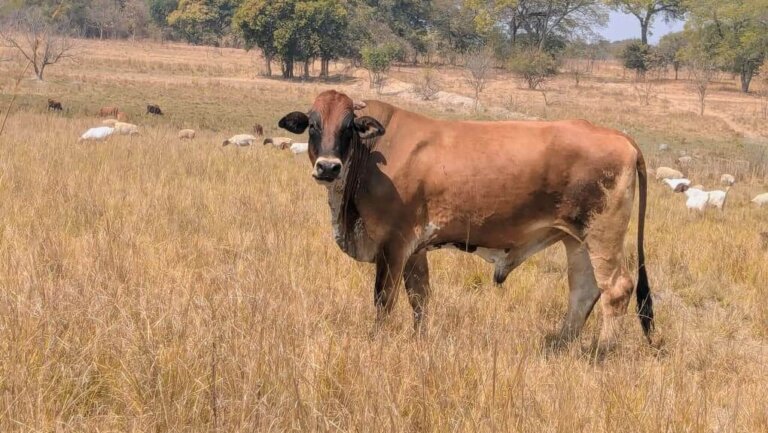
The change from uncontrolled, continuous grazing to a more sustainable approach to livestock and rangeland management is the solution.
An integrated approach that considers animal welfare, soil health, biodiversity and sustainable land management is possible in organic livestock production.
In fact, many of the practices in the livestock sector already in place in Namibia correspond to the standards set for organic (e.g. free-range production, limited use of growth hormones or antibiotics): according to the KHSA Organic Livestock Factsheet Series.
In addition, organic livestock management can also support climate action through good management.
Healthy grasslands can sequester carbon underground with their rich root systems. In a well-managed grazing system, grasses can recover and the soil can regain its cover. This will also improve the land’s ability to hold water and carbon.
How organic livestock management can help restore the land
-
Restore grass cover
Rotational grazing and planned grazing allow farmers to control where and how long the livestock is kept in certain areas. This gives vegetation time to recover and protects the soil from erosion.
-
Increase soil carbon
Healthy rangelands are natural sinks of carbon dioxide through photosynthesis. Most of the carbon is returned to soil through roots and decaying plants. Good management practices of soils can enhance carbon storage and improve soils structure and retention of water.
As explained in the Malawi Sustainable Food Systems Brief, one of the major advantages of agroecology is its triple benefits of lowering emissions, increasing resilience and absorbing carbon into soils and trees.
-
Less pressure on forests
Healthy rangelands support livestock. This can help farmers to keep regular income sources. This together with alternative energy sources and other livelihoods can help to lessen the dependence on charcoal production.
-
Trees and livestock together
Another option for rehabilitation of degraded landscapes is agroforestry. Planting appropriate tree species on the grazing lands will give shade, fodder and protect soils and provide wood for the household, and therefore reduce the pressure on natural forests.
Namibia: Lessons for Southern Africa
A number of lessons can be learned from Namibia when it comes to livestock production and management of rangelands.
In Namibia, a significant proportion of agricultural production is livestock production. The Namibian beef is well known in international markets (KHSA Organic Livestock Factsheet Series).
The country has an opportunity to leverage its existing free range livestock systems to embrace more sustainable and organic production practices.
For livestock farmers, it provides opportunities to:
- Participate in local and international markets that place a premium on the production of sustainable meat.
- Improve grazing practices and rehabilitate rangeland systems.
- Reduce pressure on natural resources.
As the KHSA Factsheet explains:
“Livestock farmers have the potential to positively impact the state of the country’s rangelands by converting to more ecologically sound management practices.”
Namibia’s experience shows that livestock production and environmental protection do not have to work against each other. The way animals are raised and land is managed makes a difference.
Building Trust Through Verification and Support
For organic and sustainable livestock production to grow, farmers need systems that verify their practices and build consumer confidence.
Organic certification: Accredited third-party certification helps verify compliance with organic production standards. This is particularly important for farmers targeting regulated export markets.
Participatory Guarantee Systems (PGS): For local markets, PGS offers a community-based approach to verifying organic practices. Farmers, consumers and other stakeholders work together to assess and support producers. This makes verification more accessible to smallholder farmers.
Supportive policies: Governments also have a role to play. Policies should encourage sustainable land management, protect forests and support communities in adopting better farming practices. The Zambia Multi-Ministerial Policy Brief calls for stronger environmental policies and improved monitoring involving local communities.
From Charcoal to Carbon: Restoring Our Land Together
Reversing deforestation requires more than asking communities to stop cutting trees. It means addressing the economic pressures that drive them to depend on charcoal in the first place.
Farmers need alternative sources of energy, reliable markets, practical training and support to adopt sustainable farming and livestock practices.
Organic rangeland management is one part of this wider solution. By restoring grass cover, improving soil health, protecting biodiversity and increasing carbon storage, well-managed livestock systems can help rebuild degraded landscapes.
The shift from charcoal to carbon is about changing how we use and care for our natural resources.
Whether you are a livestock farmer, policymaker, development organisation or consumer, you have a role to play.
We cannot keep burning our forests and expect our land to sustain future generations. It is time to restore our rangelands, protect our forests and invest in farming systems that give both people and nature a chance to thrive.
Download the Knowledge Products below for more information:
Introduction to the Organic Livestock Factsheet Series – KHSA: Learn how organic livestock production can positively impact rangelands.
Why Sustainable Food Systems Matter for Malawi: Understand the deforestation crisis and how agroecology restores degraded areas.
Agroecological Multi-Ministerial Policy Briefing Pack – PELUM Zambia: Explore policy recommendations for sustainable land and environment management.
SFHC Facilitator’s Guide to Participatory Theatre: Use the “Charcoal Family” script to start community conversations about deforestation.

Author: Rabecca Mwila
Rabecca Mwila is a passionate advocate for sustainable agriculture and environmental stewardship. With a background in climate change and communications, she has spent years telling the untold stories of the realities of climate change, environmental and climate injustices and how they affect vulnerable communities in Africa and beyond