The Namibian sun is unforgiving, and the soil tells a story of scarcity.
Standing on a slope in this dry region, you can see the effects of the last rainfall. Instead of soaking into the soil to nourish plant roots and replenish groundwater, the water rushed downhill, carrying away the fertile topsoil and leaving behind dry, hard ground.
This was the exact landscape that greeted the Knowledge Hub for Organic Agriculture and Agroecology in Southern Africa (KHSA) Leadership Collective at Farm Krumhuk on the second day of their meeting in Namibia.
The Collective, comprising the heads of institutions and partner organisations for KHSA from Malawi, Zambia, South Africa and Namibia, had gathered for a critical purpose. As KHSA transitions into a regional network within Knowledge Centre for Organic Agriculture and Agroecology in Africa (KCOA), the Collective is reflecting on KHSA’s future priorities, what it should achieve and how it can stay connected to its multiplier communities. The agenda for 2027 and beyond was clear: We must transition from a time-bound “project” into a permanent, self-sustaining “network.”
However, as any good agroecologist knows, you cannot build a resilient network in a boardroom alone. You have to build it in the soil.
When Water Runs Off
In landscaping the greatest threat is runoff. If a farmer ignores the slope of their land, the limited rains of Namibia wash away, leaving the crops to wither.
To survive the dry spells, we needed to learn how to slow down, spread out and sink our most valuable resources. They needed to stop the runoff.
Dirt Under the Fingernails of Regional Leaders
According to the Namibian Organic Association’s Guide to Hosting a Permaculture Blitz, a “permablitz” is a community-driven, one-or-two-day event where volunteers come together to design or re-design a landscape using permaculture principles. It is about moving from theory to practice, building sustainable landscapes while simultaneously building the social fabric of the community.
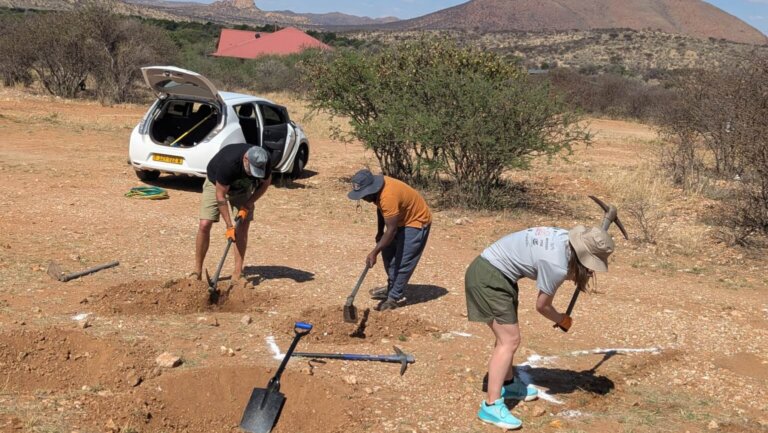
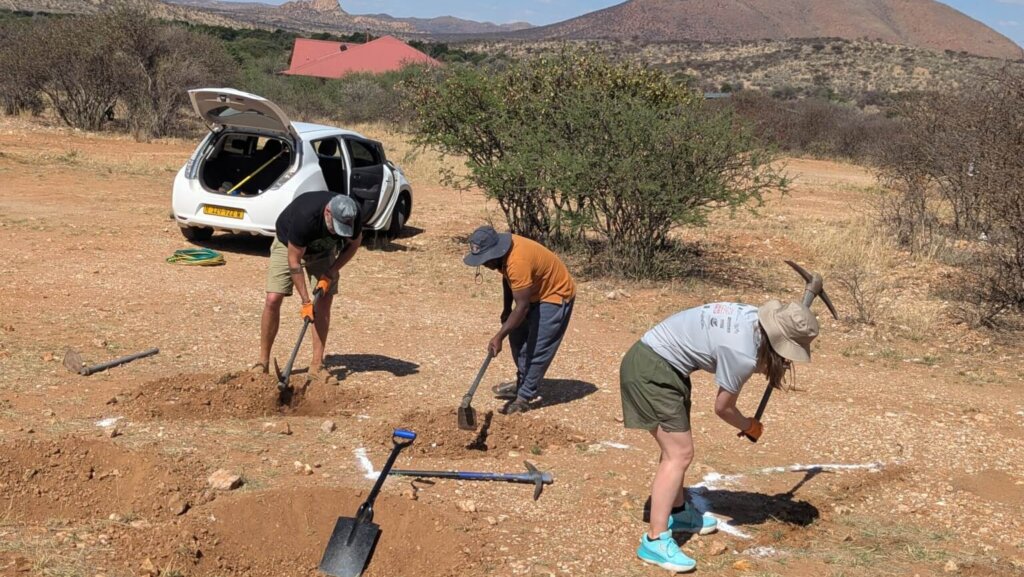
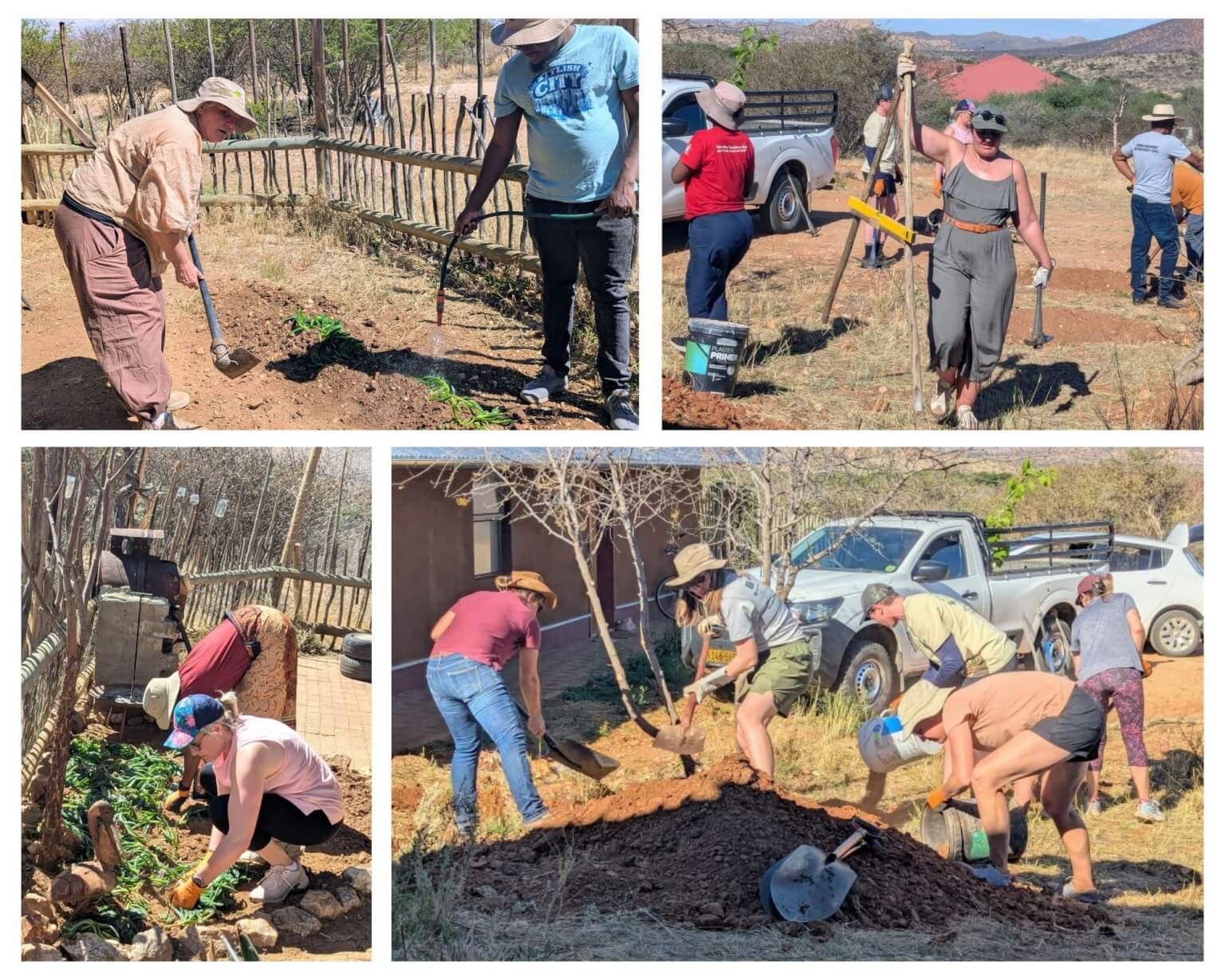
On day two of the meeting, the regional heads of KHSA got spades, pickaxes and gloves. They were tasked with transforming a degraded, sloping area into a thriving, water-harvesting ecosystem.
Guided by the core permaculture principle of “Catch and Store Energy”, the Collective implemented a series of strategic earthworks designed to trap, retain and sink every possible drop of rain.
Here is how the Leadership Collective rehydrated the Namibian slope:
-
Demi-Lunes (Semi-Circular Bunds)
To stop water from racing down the slope, they dug demi-lunes, crescent-shaped earth bunds with the open ends facing uphill.
- The Function: These act as micro-catchments. When the rain falls, the demi-lunes catch the runoff, holding it in place long enough for it to slowly infiltrate the deep soil. They create perfect, moisture-rich pockets for planting drought-tolerant trees and shrubs.
-
Mini Contour Lines with Rocks
Using the natural fall of the land, they laid out mini contour lines reinforced with stones.
- The Function: Rocks slow down flowing water and reduce its force. As the water slows, it deposits sediment, helping rebuild the topsoil. The water also has more time to soak into the ground instead of washing away the soil and forming destructive gullies.
-
The Rehydration Pit
At key convergence points where water naturally wanted to pool and escape, we dug deep rehydration pits filled with organic matter and loose soil.
The Function: Rather than allowing water to collect on the surface and evaporate, these pits help it soak deep into the soil, keeping the ground moist for longer and replenishing underground water sources.
-
Mulching
Every bare soil they disturbed was immediately covered with a thick layer of dry, organic mulch.
The Function: Under Namibia’s hot sun, bare soil quickly loses moisture. Mulch covers the ground, reduces evaporation, keeps the soil cool and provides food for beneficial soil organisms that help maintain healthy soil structure.
-
Water-Guiding Bunds
They built low, raised earth walls to guide the flow of water across the land.
The Function: These bunds catch runoff from higher, uncultivated areas and direct it towards planted areas and demi-lunes. This helps make better use of every drop of rainwater.
Sinking Knowledge into the Network
As the Leadership Collective stepped back to look at the transformed slope, the deeper meaning of their work became clear.
The earthworks they built to harvest water are exactly what is being built for the future of agroecology in Southern Africa.
- The demi-lunes are the local community hubs, catching and nurturing grassroots innovation.
- The contour lines are our shared standards and policies, slowing down the rush of industrial agriculture and protecting our topsoil.
- The rehydration pits are our knowledge products, like the Permaculture Blitz Guide sinking deep, life-saving information into the roots of our farming communities.
By transitioning from a “project” to a “network” in 2027, the KHSA partners from Malawi, Zambia, South Africa and Namibia are ensuring that the knowledge, funding and momentum they have generated will not wash away.
Download a Guide to hosting a Permaculture Blitz by the Namibian Organic Association.

Author: Rabecca Mwila
Rabecca Mwila is a passionate advocate for sustainable agriculture and environmental stewardship. With a background in climate change and communications, she has spent years telling the untold stories of the realities of climate change, environmental and climate injustices and how they affect vulnerable communities in Africa and beyond