Every harvest takes something from the soil.
For many maize farmers, replacing those nutrients has become one of the biggest challenges to maintaining healthy yields. Years of continuous cultivation gradually reduce soil fertility, making it harder for crops to thrive and increasing the need for soil restoration. For organic and agroecological farmers, the answer is not simply adding more nutrients, but rebuilding the soil itself.
One locally available resource is proving to be a valuable ally in that effort: palm kernel cake (PKC).
Often regarded as a by-product of palm oil processing, palm kernel cake has long been used as livestock feed. However, when incorporated into compost, it becomes a nutrient-rich organic amendment capable of improving soil fertility, supporting stronger maize growth, and giving agricultural waste a second life.
From Agricultural Waste to Valuable Compost
Across Nigeria’s palm oil-producing communities, large quantities of palm kernel cake are generated every year. While much of it is used as animal feed, significant amounts remain underutilised despite their potential value to crop production.
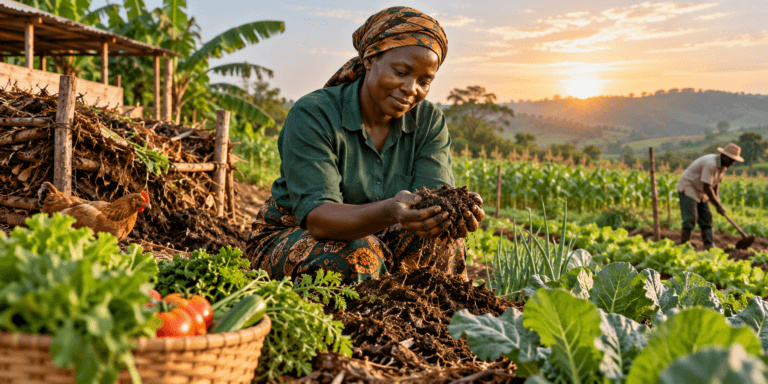
Composting palm kernel cake transforms this by-product into a valuable soil amendment. Rich in organic matter and essential plant nutrients, it contributes to healthier soils by improving soil structure, increasing organic carbon, and gradually releasing nutrients that crops can access over time.
Unlike quick-release inputs that provide only short-term benefits, compost continues improving soil health long after it has been applied. This makes it especially valuable for farmers who cultivate the same land season after season.
What Does the Evidence Show?
Studies conducted in Nigeria consistently demonstrate the value of compost enriched with palm kernel cake for maize production.
One greenhouse study found that although other fertility sources produced faster initial growth, compost enriched with palm kernel cake continued improving maize performance even during a second planting without any additional soil amendment. Plants grown in the compost-treated soil developed taller stems, produced more leaves, and recorded greater dry matter than untreated plots. One compost treatment increased plant dry weight by 62% during the first planting and 66% during the second planting compared with unfertilised soil. These findings suggest that compost continues feeding the soil beyond a single growing season.
Other Nigerian studies have reached similar conclusions. Compost blends containing higher proportions of palm kernel cake consistently produced taller maize plants and supplied greater quantities of important nutrients such as nitrogen, potassium, calcium, magnesium and essential micronutrients. Researchers also observed that allowing compost to cure for longer periods improved its nutrient content, making the finished compost even more beneficial for crop production.
Taken together, the evidence points to one important conclusion: palm kernel cake is more than a waste product. It is a valuable ingredient for producing nutrient-rich compost that supports healthier maize crops and healthier soils.
Why Does It Work?
The strength of compost lies not only in the nutrients it contains but also in how those nutrients are released.
As compost breaks down gradually, nutrients become available over an extended period instead of all at once. At the same time, the added organic matter improves soil structure, enhances water-holding capacity, encourages beneficial soil organisms, and supports long-term nutrient cycling.
Palm kernel cake further enriches this process by supplying additional nutrients, particularly potassium, while increasing the overall quality of the compost. The result is a soil amendment that not only nourishes the current crop but also leaves the soil in better condition for future planting seasons.
For farmers committed to organic agriculture, this gradual improvement in soil health is one of compost’s greatest strengths.
Practical Lessons for Farmers
The findings offer several practical lessons that farmers, extension officers and organic agriculture practitioners can apply.
- Use locally available resources. Palm kernel cake is widely available in many palm-producing communities and can become an affordable ingredient for producing quality compost instead of being discarded as waste.
- Allow compost to mature properly. Well-cured compost generally contains higher concentrations of plant nutrients than compost that is used too early. Giving compost enough time to decompose improves both its quality and effectiveness.
- Build soil, not just crops. Healthy soils develop over time. Compost contributes organic matter that continues improving soil fertility long after the first harvest, making it an important investment for sustainable crop production.
- Think beyond one planting season. The benefits of compost are cumulative. Regular application helps improve soil structure, nutrient availability and biological activity, supporting productivity over multiple cropping cycles.
Turning Waste into Opportunity
Using palm kernel cake for compost production also reflects an important principle of agroecology: making better use of locally available resources.
Instead of allowing agricultural by-products to become waste, farmers can recycle them back into their fields, where they contribute to soil restoration and crop productivity. This circular approach not only reduces waste but also strengthens the connection between crop production, natural resource management and environmental sustainability.
For Nigeria’s growing organic agriculture sector, innovations like compost enriched with palm kernel cake demonstrate how simple, locally adapted solutions can improve both productivity and resilience.
The Takeaway
Healthy maize begins with healthy soil.
Palm kernel cake may be a by-product of palm oil processing, but when transformed into compost it becomes a valuable resource for restoring soil fertility and supporting sustainable maize production.
Evidence from Nigerian studies shows that compost enriched with palm kernel cake can improve plant growth, supply essential nutrients, and continue benefiting the soil beyond the first harvest. For organic farmers looking to reduce waste, make better use of local resources, and build healthier soils for future seasons, it is a practical solution worth considering.
Download Full Article to Learn More
This article shares the highlights, but the complete knowledge product provides a deeper look at:
- how the compost was prepared and applied
- the application rates used in the trial
- plant growth and nutrient uptake results
- practical lessons for improving maize production with organic amendments

Author: Hepzibah Ebe
Experienced and results-driven Communications expert with over nine (9) years of expertise in developing and executing effective communication strategies, including more than two (2) years of specialization in agroecology