Most of us were handed a broken idea from the start. We were told that farming means managing land, controlling inputs, and pushing the soil to produce. Nobody told us the soil was already doing the work, and that we were getting in the way.
Across sub-Saharan Africa, millions of smallholder farmers are watching their yields shrink, their input costs climb, and their land grow harder to work with every season. The common assumption is that the answer is more fertiliser, better seed, or access to irrigation. But for a growing number of farmers making the shift to organic practice, the real answer started underground.
This post is for anyone who has ever wondered whether there is a better way to farm, and whether the soil they are standing on has more to give than they have been led to believe. It does. Here is what is actually happening beneath your feet, and what you can do about it.
Your Soil Is Alive. Here Is Why That Changes Everything.
What Conventional Farming Did to Your Soil
Conventional agriculture taught us to see soil as dirt, an inert medium to pour nutrients into. Organic farming asks you to unlearn that. Once you do, the way you farm will never be the same.
Pick up a handful of healthy, undisturbed forest soil and you are not just holding particles of rock and organic matter. You are holding billions of living organisms: bacteria, fungi, nematodes, earthworms, protozoa, all working together in a system more complex than anything we have ever engineered. This is the world beneath your feet, and your first responsibility as an organic practitioner is to protect it.
Decades of synthetic fertiliser use, repeated tillage, and monocropping have degraded soils across sub-Saharan Africa. When you add nitrogen from a bag, you bypass the microbial networks that nature uses to cycle nutrients. Over time, those networks weaken. Soil structure collapses. The land becomes dependent on purchased inputs the same way a hospital patient becomes dependent on a drip. Remove the drip, and nothing grows.
This is not alarmism. It is what field research across Nigeria, Kenya, Tunisia, and Zambia consistently shows. And it is exactly the situation that organic farming asks you to step out of.
Key Insight: Only about 0.2% of Africa’s agricultural land is currently under certified organic management, yet the continent holds some of the world’s most biologically diverse soils. The potential for restoration is enormous.
How to Rebuild Soil Fertility Without Chemicals
The approach is not complicated, but it requires patience and consistency.
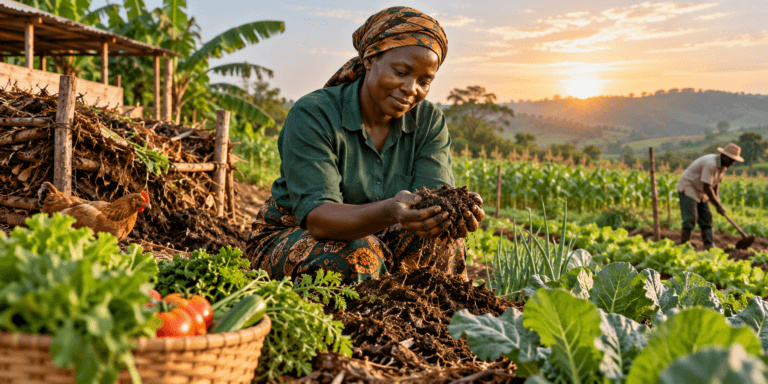
Compost is your foundation. A well-made compost pile layered with green material (nitrogen-rich), dry material (carbon-rich), and a little moisture will produce a dark, crumbly amendment that feeds your soil community rather than bypassing it. Aim for a carbon-to-nitrogen ratio of roughly 30:1, which means about three parts dry matter to one part green material by volume.
Beyond compost, cover cropping is one of the most underused tools available to African smallholder farmers. Planting legumes like cowpea, mucuna, or lablab between crop cycles does several things at once. It fixes nitrogen from the air, suppresses weeds, and adds organic matter when slashed and incorporated back into the soil. In trials across West Africa, mucuna-based systems have shown yield improvements of 50 to 200 percent in the following maize crop, without a single bag of purchased fertiliser.
Why Mulching and Minimum Tillage Matter
Every time you till deeply, you break apart fungal networks called mycorrhizae. These networks extend the reach of plant roots by thousands of times, helping crops access water and micronutrients far beyond what their own roots could ever reach alone.
Minimum tillage, working only the top few centimetres of soil, protects these networks. When you combine it with mulching to retain moisture and regulate soil temperature, you create the conditions for biological activity to thrive year round, not only during the rains.
The transition will not feel instant. In the first one to two seasons, your yields may hold steady or dip slightly while soil biology rebuilds. This is normal and expected. Farmers who push through this period consistently report that by the third season their soils hold water better, their input costs are lower, and their yields are equal to or better than before the transition.
Your soil is not just a growing medium. It is the engine of your entire farm. Feed it well, and it will feed your crops, your family, and eventually your market.
Explore knowledge products developed for African organic practitioners on https://kcoa-africa.org/ factsheets, videos, training guides, and a multiplier network connecting practitioners across 17 African countries.
Registration is free.

Author: Hepzibah Ebe
Experienced and results-driven Communications expert with over nine (9) years of expertise in developing and executing effective communication strategies, including more than two (2) years of specialization in agroecology