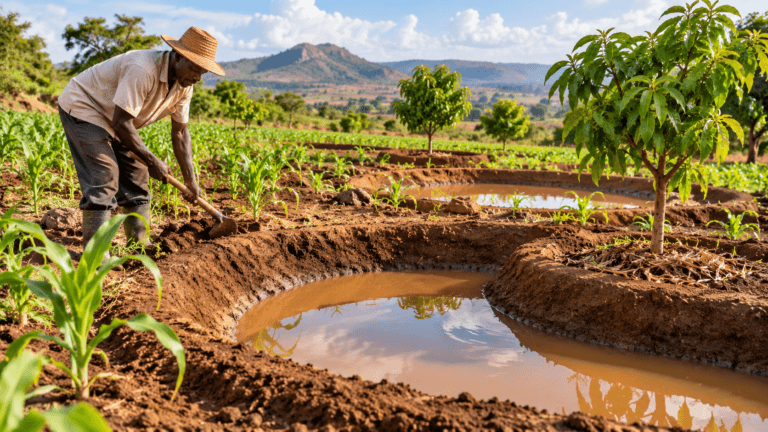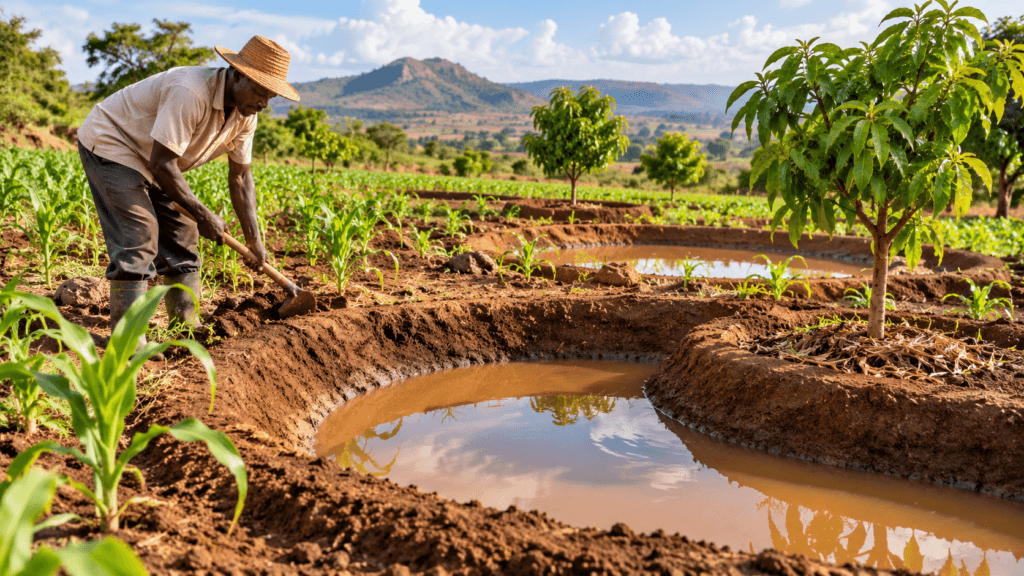
Rainfall is one of the most valuable resources available to farmers, yet much of it can be lost as surface runoff. On bare, compacted or degraded soils, heavy rainfall can quickly move across the field, carrying away topsoil and nutrients while leaving crops with insufficient moisture when rainfall stops.
Water harvesting pits can help farmers capture and slow runoff, improve water infiltration and make better use of rainfall. When properly designed for local soil, slope and rainfall conditions, these simple structures can contribute to soil moisture conservation, erosion control and more resilient farming systems.
Across West Africa, farmers face different water management challenges. In parts of the Sahel and northern savanna, rainfall may be low and unpredictable, while areas with higher rainfall may experience intense storms, runoff and soil erosion. This means that the most suitable water harvesting approach depends on the landscape and the farmer’s objective.
Water harvesting pits are not a single technology. They include different structures designed to capture, store or encourage the infiltration of water. Understanding the differences can help farmers choose an approach that fits their farm.
What are water harvesting pits?
Water harvesting pits are excavated structures that collect rainfall or surface runoff and either hold the water temporarily, allow it to infiltrate into the soil or store it for later use.
The basic principle is simple: instead of allowing rainfall to run rapidly off the farm, the structure slows or intercepts the water, giving it more time to enter the soil or remain available for use.
A useful planning principle is:
1 millimetre of rainfall falling on 1 square metre of land is equivalent to approximately 1 litre of water.
For example, a 30 mm rainfall event over a 100 square metre catchment represents 3,000 litres of rainfall. The actual amount of runoff will be lower because some water infiltrates, evaporates or is intercepted by vegetation. However, the calculation illustrates how much water can potentially be managed through appropriate harvesting structures.
The right structure depends on:
- Soil type and infiltration capacity
- Rainfall amount and intensity
- Slope and landscape position
- The amount of runoff generated
- The crop or vegetation being supported
- Whether the goal is infiltration, erosion control or water storage
- Available labour and materials
Why water harvesting matters for farmers
Water harvesting is particularly valuable where rainfall is seasonal, unpredictable or concentrated in heavy storms.
Capture more of the rain that falls on the farm
Water harvesting structures can slow runoff and give rainfall more time to infiltrate into the soil rather than leaving the field quickly.
Improve soil moisture
When water infiltrates around the crop root zone, more moisture may remain available between rainfall events. This can be particularly useful in dry areas and during short periods without rain.
Reduce soil erosion
Fast-moving runoff can carry away fertile topsoil and organic matter. Structures that slow runoff can reduce its erosive force and help protect the soil.
Support tree establishment
Tree and orchard pits can concentrate rainfall around young trees, helping them establish in areas where moisture is limited.
Support groundwater recharge where conditions allow
Some infiltration structures can contribute to groundwater recharge when soil, geology and water quality are suitable. However, constructing a pit does not automatically mean that groundwater will be recharged.
Reduce water losses
Rather than allowing available rainfall to leave the farm quickly, water harvesting helps farmers manage the water already provided by the environment.
Choosing the right water harvesting structure
Different structures suit different farming conditions. Farmers should assess their land before deciding what to construct.
1. Zaï pits
Zaï pits, also known as planting pits, are traditionally used in parts of the Sahel and West Africa, including Burkina Faso, Niger, Mali and northern Nigeria. They are particularly suited to degraded or crusted soils in relatively dry areas and on gentle slopes.
Typical dimensions
As a starting range, zaï pits may be:
- 20 to 30 cm wide
- 10 to 20 cm deep
- Spaced approximately 60 to 100 cm apart
- Arranged in staggered rows
These dimensions should be adapted to local soil and farming conditions rather than treated as fixed standards. The excavated soil is typically placed on the downslope side of the pit to form a small ridge.

How they work
The pits collect runoff and concentrate water around the planting area. Farmers may add well-rotted manure or compost to improve soil fertility and organic matter. Seeds are planted inside the pits rather than on the flat ground. Because digging can require considerable labour, farmers may start with a small area and expand gradually. Farmer groups and work groups can also help spread the labour required.
2. Half moons or demi-lunes
Half moons are shallow, semicircular structures used to capture runoff and rehabilitate degraded or bare land. They can be useful for:
- Degraded farmland
- Bare patches
- Grazing areas
- Areas with gentle slopes
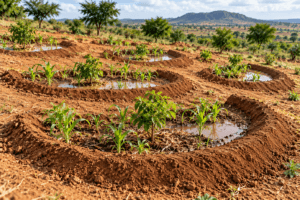
A typical half moon may have a diameter of approximately 2 to 4 metres, with the open side facing uphill. The excavated soil forms a raised bund around the curved side. Half moons can be arranged in staggered rows so that overflow from one structure is intercepted by another further downslope. Crops, legumes, grasses or trees can be established inside the basins, depending on the purpose of the land.
3. Infiltration pits
Infiltration pits are designed primarily to hold runoff temporarily and encourage it to soak into the surrounding soil. They can be useful where runoff is contributing to erosion or where improving soil moisture is the main objective. A simple infiltration pit might be around 1 metre long, 1 metre wide and 0.5 metres deep, but dimensions should be adapted to local conditions and expected runoff.
Important considerations
- Avoid placing infiltration pits in areas that remain waterlogged.
- Avoid very poorly drained soils unless the design has been adapted for those conditions.
- Water should not remain stagnant for prolonged periods.
- Keep pits away from latrines, wells, animal pens and buildings.
- Ensure runoff entering the structure is not contaminated.
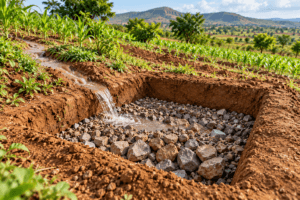
If water remains in an infiltration pit for several days, the structure may need to be modified or a different water management approach considered.
4. Tree and orchard pits
Tree pits can help farmers establish fruit trees, agroforestry species and other perennial plants, particularly in dry areas or on poor soils.
A common approach is to:
- Dig a planting hole, often around 60 cm wide and 60 cm deep, depending on the soil and tree species.
- Mix suitable topsoil with well-rotted compost or manure.
- Return the soil mixture to the planting hole.
- Plant the tree.
- Shape a shallow basin around the tree to collect runoff.
- Apply mulch around the tree while keeping the mulch away from direct contact with the stem.
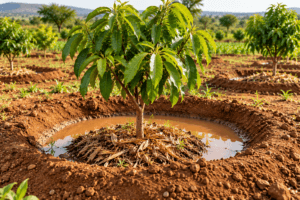
The basin should be adapted to local rainfall and soil conditions. In high-rainfall areas or heavy soils, a deep basin may contribute to waterlogging and should be avoided.
5. Contour trenches and bunds
Contour trenches are elongated structures constructed across sloping land along the contour. Their purpose is to slow water moving downhill, allowing more time for infiltration and reducing the speed at which runoff can erode the soil. Stone and earth bunds can work on a similar principle.
Important rules
Contour structures require careful layout.
- The structure should follow the contour as accurately as possible.
- Steeper slopes generally require closer spacing.
- Safe overflow points should be provided where necessary.
- Bunds can be stabilised with grass or other suitable vegetation.
- Farmers working on steep slopes or managing large catchments should seek technical guidance before construction.
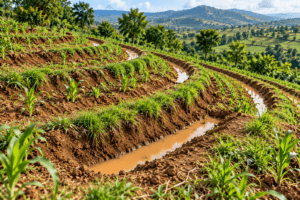
Poorly aligned contour structures can concentrate water in one location and potentially create erosion problems rather than solve them.
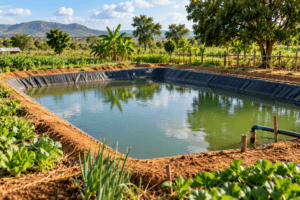
6. Storage pits and ponds
Storage pits and small ponds are designed to retain water for later use, such as watering vegetables or livestock. Where the soil drains rapidly, a lining may be necessary to reduce seepage. Depending on local conditions, materials may include compacted clay or an appropriate liner. Storage structures also require careful safety planning. Deep or open structures should be protected from children and livestock. Stored water should not be assumed to be safe for drinking because runoff can carry soil, manure and other contaminants.
Assess your farm before you dig
One of the most important steps in water harvesting is also one of the simplest: observe the farm first.
Walking around the farm after rainfall can reveal how water behaves across the landscape.
Look for:
- Areas where water naturally flows
- Places where water collects
- Small channels or gullies beginning to form
- Areas where water remains for long periods
- Bare or sealed soil
- Crops that appear stressed or stunted
- Areas experiencing repeated erosion
These observations can help determine whether the main problem is insufficient infiltration, excessive runoff, poor drainage or a need for water storage.
A simple soil infiltration test
Farmers can carry out a basic field test to understand how quickly water moves into the soil.
- Dig a hole approximately 30 cm deep and 30 cm wide.
- Fill it with water and allow the water to drain once, wetting the surrounding soil.
- Fill the hole again.
- Observe how long the water takes to drain.
As a general field guide:
- Under one hour: the soil drains relatively quickly.
- One to six hours: the soil has moderate drainage.
- Still holding water after 24 hours: the soil may have poor drainage or compaction.
This is only a field rule of thumb, not a laboratory soil test. Testing more than one location can provide a better picture of conditions across the farm.
How to estimate the amount of runoff
A simple calculation can help farmers understand how much water a structure may need to handle.
Runoff volume
Runoff volume (litres) = Catchment area (m²) × Rainfall (mm) × Runoff fraction
The runoff fraction represents the proportion of rainfall that becomes surface runoff.
For example:
- Catchment area = 100 m²
- Rainfall = 30 mm
- Estimated runoff fraction = 0.3
100 × 30 × 0.3 = 900 litres
This means approximately 900 litres of runoff could reach the structure under those assumptions.
A 1 m × 1 m × 0.5 m pit has a theoretical capacity of 500 litres. In this example, the farmer would therefore need to consider a larger structure, multiple structures or a safe overflow arrangement.
The calculation is a planning aid rather than a precise prediction. Actual runoff varies considerably with soil condition, slope, vegetation cover, rainfall intensity and land management.
How to mark contours using a simple A-frame
Farmers do not necessarily need expensive surveying equipment to identify a contour line for small-scale field structures.
An A-frame can be made from simple materials.
Making an A-frame
- Join two straight poles, approximately 2 metres long, at the top.
- Attach a crossbar between the poles to form an “A”.
- Hang a string with a small weight, such as a stone, from the top.
- Place the A-frame on level ground.
- Mark where the string crosses the crossbar.
- Swap the legs and mark the second position.
- The midpoint between the two marks represents the level position.
Using the A-frame
Move the A-frame across the field, positioning it so that the string repeatedly reaches the level mark.
Mark each position with a peg. The resulting line provides a guide for constructing a contour-based structure.
For larger farms, steep slopes or complex landscapes, professional surveying or extension support is advisable.
Step-by-step: Building a water harvesting structure
Once the appropriate structure has been selected, construction can follow these general steps.
1. Mark the area
Mark out individual pit positions or contour lines before digging.
2. Separate topsoil from subsoil
Where crops or trees will be planted, keep the more fertile topsoil separate and return it to the planting area together with appropriate organic matter.
3. Excavate according to the design
Dig to the required dimensions, taking into account the soil, slope and expected runoff.
4. Build and stabilise the structure
Place excavated soil where it will safely form the required bund or ridge. Firm the soil and use stones or suitable vegetation to stabilise vulnerable areas.
5. Add organic matter where appropriate
For planting pits, compost or well-rotted manure can improve soil organic matter and fertility.
6. Apply mulch
Mulch can help reduce evaporation, protect soil from crusting and reduce the amount of sediment entering the pit.
7. Plant at the appropriate time
Where the structure is designed for crop or tree production, planting should be timed with suitable rainfall and local growing conditions.
When should farmers construct water harvesting pits?
In many farming systems, the best time to construct pits and contour structures is before the main rains begin.
The dry season can provide an opportunity to:
- Dig new pits
- Mark contours
- Repair existing structures
- Gather compost or manure
- Collect stones and other materials
- Organise labour
Once the rains begin, farmers can observe how the structures perform and make adjustments.
A simple seasonal guide
| Period | Activity |
|---|---|
| Before the rains | Dig pits, mark contours, gather materials and repair structures |
| Early rains | Inspect structures after heavy rainfall and plant when conditions are suitable |
| Mid-season | Maintain vegetation, weed where necessary and replenish mulch |
| After heavy storms | Check for sediment, erosion, cracks and overflow damage |
| End of rainy season | Remove excess sediment, assess performance and plan improvements |
The exact timing should be adapted to the local rainfall calendar.
Maintaining water harvesting structures
Water harvesting structures require regular observation and maintenance.
After heavy rainfall, check for:
- Sediment filling the pit
- Blocked entry points
- Crusted pit bottoms
- Cracks or collapsed sides
- Erosion around the edges
- Overflow channels forming unexpectedly
- Standing water lasting too long
- Damage to grass or other vegetation stabilising bunds
Sediment can be removed and, where appropriate, returned to the field because it may contain valuable soil and nutrients.
If a pit repeatedly fills with sediment, the problem may be occurring upslope. Maintaining ground cover, mulch or grass strips can help reduce the amount of soil reaching the structure.
Common problems and how to address them
| Problem | Possible cause | What to consider |
|---|---|---|
| Water remains in the pit for several days | Heavy clay, compaction or excessive depth | Improve drainage, modify the structure or consider another design |
| Pit fills with sediment | Bare or eroding soil upslope | Add mulch, vegetation or grass strips and address the source of erosion |
| Bund breaks during storms | Poor alignment, insufficient height or no safe overflow | Repair and stabilise the bund and provide a safe overflow point |
| Crops in zaï pits remain stressed | Low organic matter, inadequate moisture capture or unsuitable spacing | Improve organic matter, mulch and reassess pit design |
| Plants become waterlogged or yellow | Poorly drained soil | Reduce basin depth, improve drainage or use a different structure |
| Mosquitoes breed in the pit | Water remains stagnant for too long | Improve drainage or use a properly designed storage structure |
The appropriate solution depends on the specific site. Repeated problems are often a sign that the structure needs to be redesigned rather than simply repaired.
Combine water harvesting with agroecological practices
A water harvesting pit can capture water, but the condition of the soil determines how effectively that water is used.
For this reason, water harvesting works best as part of an integrated soil and farm management approach.
Farmers can combine water harvesting with:
- Compost and well-rotted manure to improve soil organic matter
- Mulching and cover crops to protect the soil surface
- Agroforestry to support deeper rooting, shade and organic matter inputs
- Farmer-managed natural regeneration where appropriate
- Legumes and intercropping to support soil fertility and biodiversity
- Grass strips to slow runoff and protect soil
- Vegetation cover to reduce erosion and improve water infiltration
These practices help shift the focus from simply capturing water to building a farming system that can **retain, use

Author: Hepzibah Ebe
Experienced and results-driven Communications expert with over nine (9) years of expertise in developing and executing effective communication strategies, including more than two (2) years of specialization in agroecology