The Stage Is Set, and the Pots Are Boiling
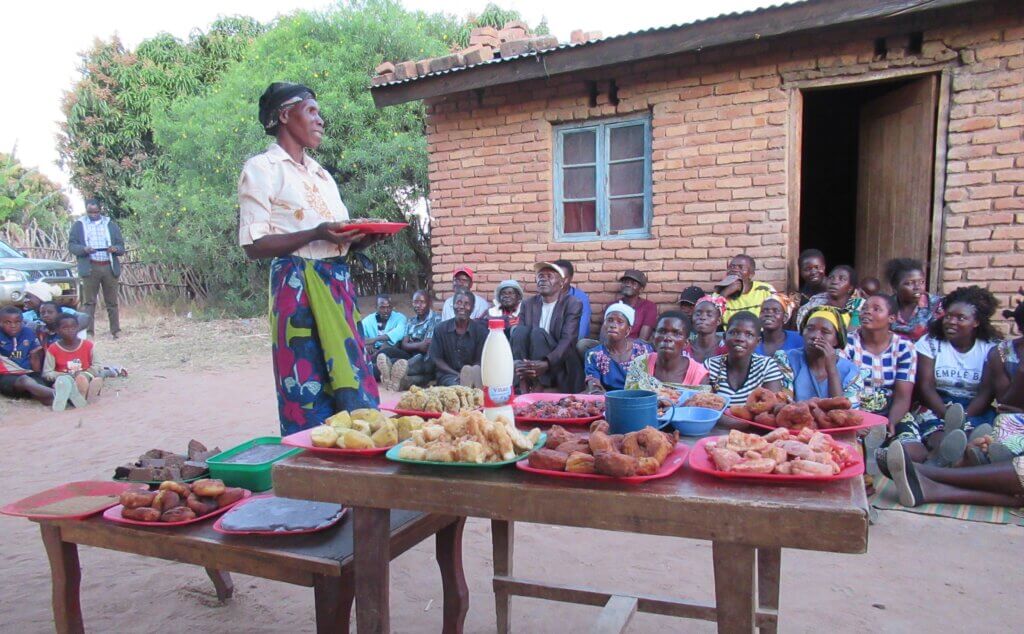
As the afternoon sun is setting, the middle of the village is alive with energy and excitement.
A group of men and women have assembled around three open fires. The air is filled with the delicious smell of roasting groundnuts and steaming pumpkin leaves (Mkhwani).
In the middle of the circle stands Alinafe, who is part of the local Farmer Research Team (FRT). She is using a wooden pestle to beat the boiled soybeans. The neighbours surrounding her are looking on closely, asking questions and tasting the creamy, homemade soy milk which she is straining using a clean cloth.
It is more than just a lunchtime get-together, it is a demonstration of community cooking. Community cooking is changing the way the village eats and thinks.
The Gap Between the Farm and the Plate
In rural Malawi and in southern Africa, agroecological farmers are managing to grow a rich variety of traditional crops which can tolerate drought. Their fields are full of soybeans, bambara nuts, millet, sorghum and groundnuts.
However, despite the diverse crops grown by community members, their diets are monotonous, mainly consisting of maize Nshima with simple relish
The Kusamala Institute’s brief, entitled ‘Why Sustainable Food and Farming Systems Matter for Malawi’, points out that the industrial food system has led to the marginalisation of traditional knowledge.
Over the years, numerous rural households have completely forgotten how to process and prepare these indigenous ‘superfoods’. When they see a sack of soybeans, they only regard it as animal feed or a cash crop to sell and are unaware of the nutritional treasure that is located right inside their stores.
The Hidden Dangers of the “Knowledge Gap”
The results are serious if we lose the knowledge of how to cook our traditional crops, with adverse effects on our physical health and on our social structure.
-
The danger involved in inadequate preparation
Traditional crops need to be properly prepared if they are to be both safe and nutritious. For instance, soybeans are the case in point. The SFHC Indigenous Recipe Book clearly states that raw or undercooked soybeans contain phytoestrogen, a substance capable of disrupting the body’s hormones. A mother who does not know that soybeans must be boiled for thirty minutes and have their outer skins removed before making soy milk might unintentionally do harm to her children. Because of this concern, lack of community training means that such a nutritious and protein-rich food is kept off the menu.
-
The Heavy and Invisible Burden That Falls on Women
In the past, the kitchen has always been considered part of “women’s domain”. It is expected of women to farm, fetch water, look after the children and to spend a lot of time pounding groundnuts or boiling beans over a smoky fire. The unequal distribution of this kind of work results in fatigue and prevents women from taking part in community leadership or in activities which generate income.
-
The cycle of hidden hunger
Children suffer from micronutrient deficiencies (stunting and wasting) because they do not have the skills needed to turn a variety of farm harvests into tasty meals for different groups. Although we have the food, we are missing the culinary plan required to realize its life-saving potential.
Where the Kitchen Meets the Stage
The Soils, Food and Healthy Communities (SFHC) project does more than just distribute leaflets in order to close the gap between the farm and the consumer. It sends out Farmer Research Teams (FRTs) to carry out lively and interactive community cooking demonstrations, combining these with participatory theatre.
Here is how this powerful combination is transforming villages:
-
Peer-to-Peer Culinary Master classes
Rather than having an outsider give a lecture to the village, it is Alinafe (who is also a farmer) who carries out the cooking demonstration. She shows her neighbours in a step-by-step manner how to safely prepare soy milk, how to mash bambara nuts with tomatoes and onions, and how to make a rich and creamy relish by mixing roasted groundnut powder into pumpkin leaves. The result is that when farmers see their fellow farmers producing tasty and nutritious meals from crops which they already grow, they no longer feel intimidated. They taste the food, ask questions and take the recipes away with them.
-
Using theatre to break down gender norms
Cooking may be practical, but the question of who does the cooking is a social one and that is where SFHC’s participatory theatre comes into play.
Prior to or whilst carrying out the cooking demonstration, the FRT will put on a brief, spontaneous skit. The actors will role-play a typical household dispute using the methods described in the SFHC Facilitator’s Guide to Participatory Theatre, specifically, a husband coming home from the fields and asking for food, while his wife is worn out from weeding and fetching water.
The performance stops and the facilitator turns to the audience and asks, “What is the way of solving this? Who says that the kitchen is only for women?”
It provides the community with a safe environment in which to question harmful cultural norms. The message is clear and encouraging, reflecting the fundamental philosophy of the SFHC Recipe Book:
The kitchen is a space which we all share so that we may keep our homes healthy.
-
Men moving forward to the mortar
At the cooking demonstrations, men are actively encouraged to take part. For example, when Alinafe shows how to make traditional peanut butter, she gives the pestle to a father who is present. While he laughs and tries to crush the roasted groundnuts into a smooth paste, the gender barrier disappears. Men then come to appreciate the physical effort involved in traditional food processing, which in turn results in a more equitable distribution of household duties.
The Harvest: Healthier Families, Stronger Communities
The far-reaching effects of these community cooking demonstrations are significant.
The Malawi Sustainable Food Systems Brief, which refers to long-term research, states that “household dietary scores rise whenever gender equity is dealt with in farming communities”. If men take on some of the chores in the kitchen, women then have more time to look after their agroecological plots and to take part in community leadership.
Meanwhile, child malnutrition decreases when families learn how to safely process soybeans and Bambara nuts.
SFHC is not only teaching the villages how to cook since it combines the practical skills demonstrated in a cooking session with the social awakening associated with participatory theatre, it is also teaching them how to heal their communities.
For more details, download the Free Knowledge Products: SFHC Indigenous Recipe Book, A Facilitator’s Guide to Participatory Theatre
Why Sustainable Food Systems Matter for Malawi

Author: Rabecca Mwila
Rabecca Mwila is a passionate advocate for sustainable agriculture and environmental stewardship. With a background in climate change and communications, she has spent years telling the untold stories of the realities of climate change, environmental and climate injustices and how they affect vulnerable communities in Africa and beyond