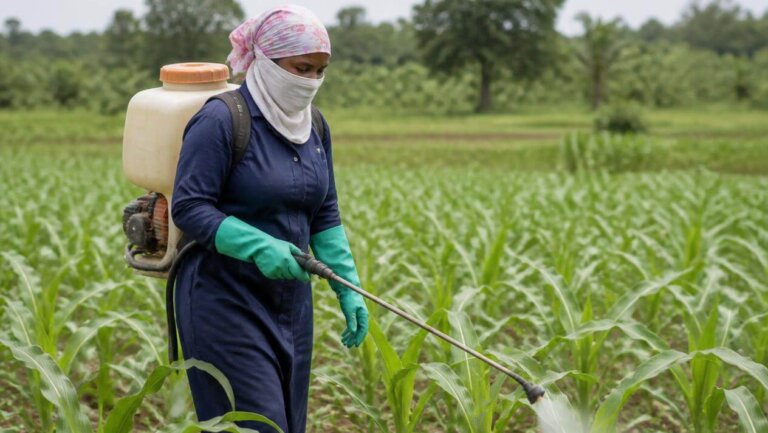
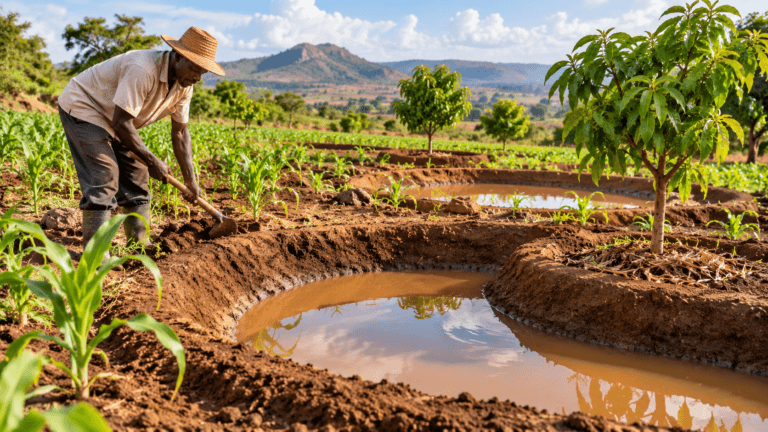
Declining soil fertility and low productivity fields before adoption of ecological practices.
In many parts of Ngoma District, farming households have long depended on continuous cultivation of the same land with limited efforts to restore soil health. Over time, this has led to declining soil fertility, reduced yields, and increasing pressure on farmers who rely heavily on the same plots to feed their families and generate income.
This was the reality for a farmer in the area whose production had steadily dropped despite consistent effort. Seasons of cultivation without adequate soil replenishment had left his land tired and less responsive. Inputs were costly, yet the harvests continued to shrink, creating uncertainty around food security and household income.
Like many smallholder farmers facing similar challenges, he was caught in a cycle where more effort did not necessarily translate into better results. The land was still being worked, but it was no longer giving back enough.
The Turning Point: Rethinking the Soil
 Access copy of the Knowledge Product; How-to-Make-Compost-Manure.pdf
The shift began when he was introduced to ecological and organic farming practices that focused on rebuilding soil health rather than forcing productivity through external inputs alone. Instead of viewing crop residues and farm waste as useless, he began to see them as valuable resources.
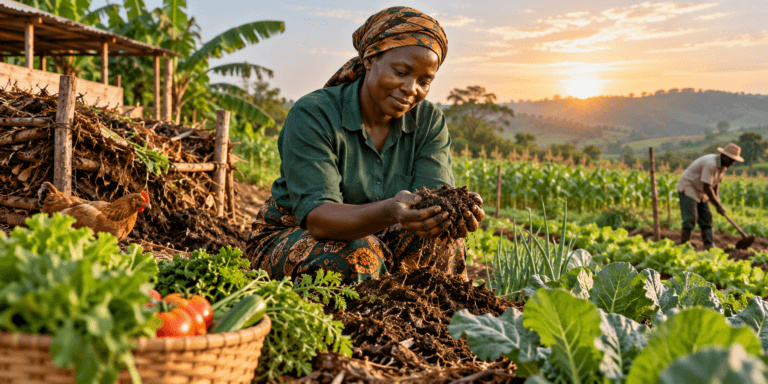
He started applying compost manure, recycling organic matter, and integrating soil restoration techniques that improved structure and fertility.
 Access copy of guide; DESIGN-AND-CONSTRUCTION-OF-COMPOSTING-STRUCTURES-AND-OF-COMPOST-MANURE-AT-THE-DELTA-STATE-POLYTECHNIC-OZORO-A-PRELIMINARY-REPORT.pdf

 Caption: On-farm composting using crop residues and animal waste to restore soil fertility.
Gradually, he also embraced broader ecological practices such as efficient resource use within the farm system, ensuring that nothing went to waste.
From Struggle to Abundance
The changes did not happen overnight, but the results became clear with time. The soil began to recover, becoming more fertile and better at retaining moisture. Crop performance improved noticeably.
Maize yields, which had previously been low and inconsistent, increased significantly on the same piece of land. Vegetable production also improved, with crops growing larger and healthier than before.
 Improved crop performance following adoption of organic soil management practices.
What once felt like a declining farm system gradually turned into a more productive and resilient one.
A Smarter, Self-Sustaining Farm System
Beyond yield improvements, the farmer’s approach evolved into a more integrated system. Crop residues were reused, animal waste was turned into organic fertiliser, and available farm resources were maximized instead of being discarded.

This reduced dependence on expensive external inputs while strengthening overall farm productivity.
Regional Learning and Knowledge Exchange
The impact of The impact of these practices continues to extend beyond a single farm. During the KCOA Transition Team Meeting held in Rwanda in June 2026, participants from across the KCOA network visited La Ferme du Lac – the KHEA Centre of Excellence managed by Albert. The visit provided an opportunity for partners to experience firsthand how ecological farming principles are being applied in practice, from compost production and integrated farm management to soil restoration and resource recycling.

The exchange highlighted the Centre’s role as a living learning hub, demonstrating practical agroecological solutions that can be adapted and replicated by farmers and practitioners across Africa.
To further showcase the Centre’s role in advancing agroecological learning and innovation, watch this short video in which KHEA Project Manager, Francis Nsanga, highlights the vision behind La Ferme du Lac – KHEA Centre of Excellence under Rwanda Organic Agriculture Movement (ROAM) and its contribution to knowledge exchange and farmer learning across the region.
https://www.youtube.com/watch?v=qiJBSCkNW4M
The visit to La Ferme du Lac was one of the highlights of the KCOA Transition Team Meeting held in Kigali, Rwanda, from 7–13 June 2026, where representatives from the five KCOA Regional Hubs came together to shape the future of the KCOA Network. The meeting combined strategic discussions with practical learning, allowing participants to witness firsthand how KHEA Centres of Excellence are translating agroecological knowledge into tangible impact for farming communities.
Read more: https://khea-africa.org/building-the-future-of-the-kcoa-network-through-collaboration-and-learning/
Restoring Hope Through the Soil

This transformation shows a simple but powerful truth: soil degradation is not a permanent condition. With the right knowledge and practices, even exhausted land can be restored and made productive again.
The farmer’s journey demonstrates how ecological and organic farming approaches can move households from struggling with declining yields to building resilient, self-sustaining farming systems that support both livelihoods and the environment.


Disclaimer:
– To learn about the KCOA Project: https://kcoa-africa.org/
– To learn about the KHEA Project: https://khea-africa.org/
– For more details on this article, please reach out to pmagino@biovisionafrica.org
– See the license statement of all KCOA content: https://kcoa-africa.org/license-statement/ , which applies to all content from hubs implementing the KCOA project.

Author: Pamella Magino
Ms. Magino Pamella joined PELUM Uganda on 1st Oct 2021 as Communications Officer for the KCOA-KHEA project. With 9+ years in Communications and Marketing, she specializes in Public Relations, Business Development, and Marketing. Pamella holds a Bachelor’s in Mass Communication (Public Relations) and is a Certified Member of PRAU. She has worked with organizations like The Nile Basin Initiative and Victoria University Kampala, crafting strategies that drive positive change