Pests can cause significant damage both in the field and after harvest. For many organic agricultural and agro-ecological farmers, synthetic pesticides is not an option when more locally available options exist.
This is where neem (Azadirachta indica) becomes particularly interesting.
For generations, neem has been used in traditional agricultural practices because of its insect-repellent and insecticidal properties. Scientific research has also investigated neem and other plant-based materials as alternatives or complements to conventional pest management. Neem contains bioactive compounds, including azadirachtin, which can affect insect feeding, growth and development.
But neem is not just one solution. Different parts of the plant can be prepared and used in different ways.
Here are three practical neem-based methods for crop pest control and grain storage.
1. Combine neem and pepper for natural pest control
Neem does not have to be used alone.
A second approach combines neem and pepper to create a plant-based pest control preparation.
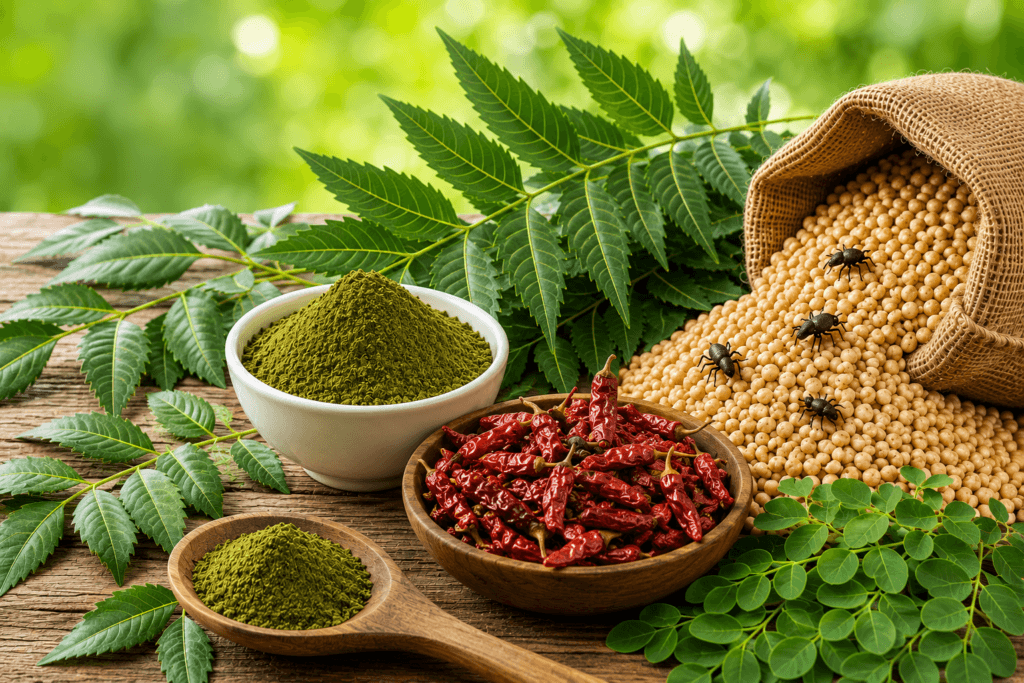
Neem contributes compounds associated with insect-repellent, antifeedant and growth-disrupting effects, while pepper can provide additional repellent properties. Plant materials containing these types of bioactive compounds have been studied for their potential to control agricultural pests.
For farmers interested in homemade botanical pesticides, combining locally available plants can provide another option for managing pest pressure.
The KCOA procedure provides a practical preparation method for using neem and pepper as a pest control treatment.
Get the full procedure here:
Download the procedure for using neem and pepper to control pests.

2. Use powdered neem leaves for pest control in crops
One of the simplest ways to use neem in agriculture is by preparing powdered neem leaves.
Dried neem leaves can be ground into a powder and applied as a botanical pest control treatment. Neem-based preparations can help repel or affect certain insect pests by interfering with their feeding and development.
This makes powdered neem leaves an option worth considering for farmers looking for natural pest control methods for crops.
The approach is particularly attractive because neem trees are widely available across many parts of Africa, making the raw material locally accessible in many farming communities.
However, the effectiveness of homemade botanical pesticides can vary. Factors such as the quality of the plant material, concentration, preparation method and target pest can influence results. Research therefore supports using these methods as part of an informed pest management approach rather than assuming that every neem preparation will work equally well.
Want the step-by-step method?
Download the procedure for using powdered neem leaves for pest control in crops.

3. Use neem and moringa leaves to protect stored grains
Pest management does not stop when crops are harvested.
Grain storage is another critical stage where farmers can lose part of their harvest. Weevils and other storage insects can damage grains during storage, reducing both quantity and quality.
Plant-based grain protectants have therefore received considerable attention, particularly because farmers in Africa and other regions have traditionally used locally available plants to protect stored agricultural products. Neem is among the botanical materials that have been extensively studied for this purpose.
One approach documented by KCOA combines neem leaves and moringa leaves for grain storage.
The idea is simple: use locally available plant materials to create conditions that can discourage storage pests and reduce grain damage.
This approach is especially relevant for smallholder farmers looking for practical ways to reduce post-harvest losses without depending entirely on commercially available chemical products.
At the same time, botanical grain protectants should be used with care. Research has found promising results for some plant materials, but effectiveness can vary considerably, and more evidence is still needed around preparation, dosage, long-term effectiveness and use under real farm storage conditions.
Learn how to prepare and use the neem and moringa method:
Download the procedure for using neem and moringa leaves to store grain.

Why are neem-based pest control methods gaining attention?
The growing interest in botanical pesticides is part of a wider search for more sustainable approaches to crop and post-harvest pest management.
For smallholder farmers, locally available plant materials can potentially offer advantages in accessibility and cost. They can also complement broader integrated pest management strategies.
Neem is particularly interesting because it has been investigated against a wide range of agricultural and storage pests, and neem-based products have been developed commercially in different parts of the world.
But natural does not automatically mean risk-free or universally effective.
The preparation and application of homemade botanical pesticides can produce different concentrations of active compounds, and their effectiveness may be lower or less consistent than commercial pesticides in some situations. Research also continues to examine questions around safety, residual effects and impacts on non-target organisms.
That is why practical knowledge and proper application matter.
From neem leaves to practical farm solutions
Neem is more than a tree commonly found around many African communities. Its leaves and other plant materials have long been explored for their potential role in natural pest control and grain protection.
From powdered neem leaves applied to crops, to neem and pepper preparations, and neem combined with moringa for stored grains, these approaches demonstrate how locally available resources can become part of practical agricultural solutions.
For farmers exploring organic farming, agroecology or sustainable pest management, botanical approaches such as these are worth understanding and testing appropriately within their local context.
The three KCOA procedures below provide practical instructions to help move from information to action:
1. Powdered neem leaves for pest control in crops
2. Neem and pepper for pest control
3. Neem and moringa leaves for grain storage
Sometimes, sustainable agriculture starts with looking differently at what is already growing around us.

Author: Hepzibah Ebe
Experienced and results-driven Communications expert with over nine (9) years of expertise in developing and executing effective communication strategies, including more than two (2) years of specialization in agroecology