Water: The Foundation of Sustainable Agriculture
Water is life and in agriculture, it is the invisible force that sustains every stage of crop development. From seed germination to plant maturity, water is essential for growth, productivity, and resilience. Yet, across Africa and other arid and semi-arid regions, water scarcity is becoming an increasingly pressing challenge.
Today, agriculture accounts for nearly 70% of global freshwater withdrawals, making it the largest water user worldwide. This reality highlights a critical paradox: while agriculture depends heavily on water, it also holds immense potential to become a key driver of water efficiency and sustainability.
Water: A Limiting Factor for Productivity
Water is not just an agricultural input, it is often the main limiting factor. Poor water management leads to reduced yields, soil degradation, and increased vulnerability to climate variability.
Globally, more than 2 billion people live under conditions of water stress, posing a direct threat to food security. In addition, inefficiencies in irrigation systems mean that up to 50% of water used in agriculture can be lost through evaporation, leakage, or poor management practices.
Improving water use efficiency is therefore essential to:
- Stabilize and increase crop yields
- Strengthen resilience to climate change
- Support farmer livelihoods
- Enable diversification into higher-value crops
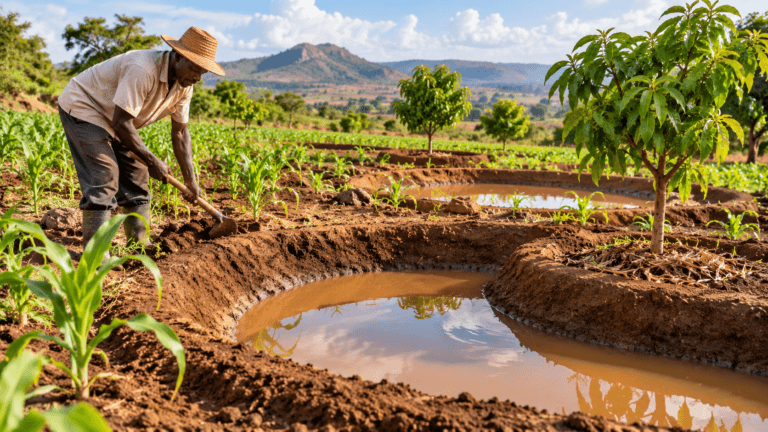
👉 To support farmers and practitioners, KCOA provides practical tools such as the Water Harvesting Pits & Trenches Poster Series, which presents simple and effective techniques to capture and conserve water in dryland farming systems:

Good Irrigation Starts with Good Observation
Efficient irrigation is not only about technology, it starts with observation. Understanding when to irrigate and how much water to apply requires careful attention to plant signals, soil moisture, and environmental conditions.
The following video illustrates a key principle promoted across KCOA hubs: good irrigation begins with good observation. By closely monitoring their fields, farmers can reduce water waste while improving productivity and crop health.
👉 Watch the video here: kcoa-africa.org/wp-content/uploads/2023/07/KHNA-EG-39-Good-Irrigation-is-Good-Observation-2.mp4
Agroecology and Organic Agriculture: Part of the Solution
Sustainable water management is at the heart of both agroecology (AE) and organic agriculture (OA). These approaches go beyond reducing inputs, they aim to restore natural processes and improve the efficiency of resource use.
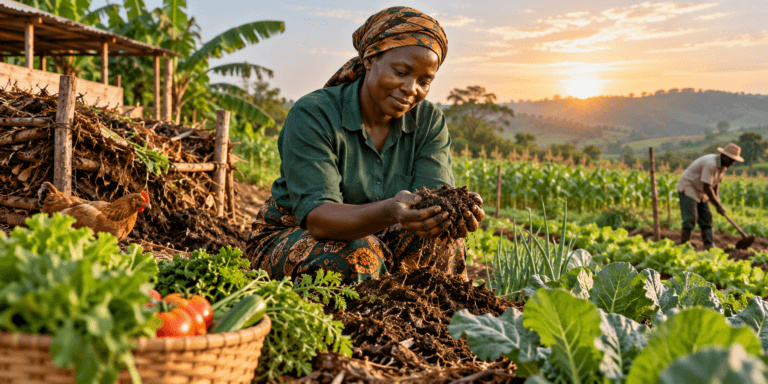
- Increasing soil organic matter improves soil structure and enhances its ability to retain water.
- A 1% increase in soil organic matter can store up to 62,000 liters of additional water per hectare, significantly improving drought resilience.
- Practices such as mulching, crop diversification, and agroforestry reduce evaporation and improve water infiltration.
🔗👉 KCOA also offers a comprehensive resource on Land Development Techniques & Water Management, highlighting practical approaches to optimize soil-water interactions and improve farm resilience.
These knowledge products demonstrate that sustainable practices are not only environmentally sound but also economically viable for smallholder farmers.
🌍 Towards Resilient Water Management
As climate change intensifies droughts and increases rainfall variability, rethinking water management is no longer optional—it has become imperative. Water is not merely a resource; it is the foundation of resilient and sustainable food systems. By improving irrigation practices, enhancing field observation, and adopting agroecological and organic approaches, farmers can optimize water use while safeguarding natural ecosystems.
The way forward is clear: agriculture must transition from being the largest consumer of water to becoming a leader in its sustainable management and stewardship.
Because in a context of growing scarcity, every drop truly counts.

Author: NAJLA DHEN
Digital Knowledge Officer and Rural Service Provider Coach within the Knowledge Hub for Organic Agriculture in North Africa (KHNA) Project