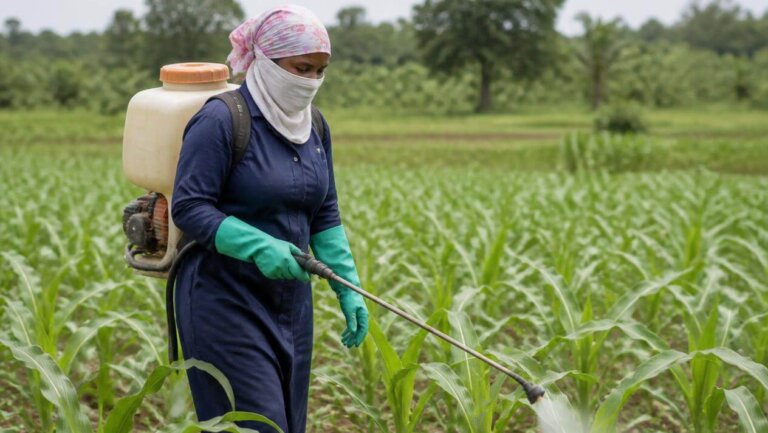
Every growing season, millions of smallholder farmers across Africa face the same twin challenges: pests and insects attacking their crops, and soils growing poorer with each harvest. The conventional solution chemical pesticides and synthetic fertilizers is expensive, increasingly unavailable, and damaging to the very soil ecosystems farmers depend on. The result is a cycle of dependency that drains household income and degrades land over time.
Agroecology offers a fundamentally different path. Rather than importing solutions, it asks: what does the farm already have? The answer, for most African farmers, is more than enough. Neem trees. Wood ash. Animal manure. Moringa. Chilli peppers. Compost. These are not second-best alternatives. They are the foundation of productive, sustainable farming.
🌱 Why does this matter now? Africa’s organic biological fertilizer market is growing at over 12% annually, driven by soil degradation affecting 83% of the continent’s arable land. Farmers who master on-farm input production today will be the ones who remain productive and profitable tomorrow.
Organic Pesticides: Protect Your Crops Without Poison
An organic pesticide works by repelling, disrupting, or killing pest insects using naturally derived compounds. Unlike synthetic chemicals, well-prepared organic pesticides break down quickly, do not accumulate in the food chain, and protect the beneficial insects, birds, and soil organisms that make your farm work.
Some preparations work by disrupting the hormonal systems of insects so they can no longer feed or reproduce. Others create conditions through smell, taste, or physical irritation that pests simply avoid. Each has its place depending on the pest, the crop, and the severity of the problem.
Plant-Based Extracts
Neem is perhaps the best known organic pesticide available to African farmers. Its active compound, azadirachtin, is one of the most extensively researched natural insecticides in the world and is effective against aphids, whiteflies, caterpillars, leaf miners, and many other common crop pests. Chilli and garlic preparations work as powerful repellents: capsaicin and allicin are chemical irritants that most pest insects will actively avoid. Wood ash, a by-product of everyday cooking fires, serves double duty as a pest deterrent against soft-bodied insects and slugs, while also contributing potassium and calcium to the soil.
🌿 Neem Leaves: View Knowledge Product →
🔥 Wood Ash: View Knowledge Product →
Animal-Derived Preparations
Beyond plants, some of the most effective and most overlooked organic pesticides come from livestock. Fermented cow urine has been used by farmers in East Africa and West Africa for generations. Its pungent smell after fermentation reliably repels a wide range of pest insects, while the urea content simultaneously delivers a mild nitrogen boost, making it one of the rare inputs that protects and feeds the crop at the same time.
🐄 Fermented Cow Urine: View Knowledge Product →
One important principle applies across all organic pesticide use: rotation matters. Just as pest populations can develop tolerance to synthetic chemicals over time, repeated use of the same organic preparation can reduce its effectiveness. Rotating between neem, chilli garlic, and wood ash sprays within a single season keeps pests from adapting and keeps your preparations working.
Liquid Fertilizers: Feed Your Soil, Feed Your Crops
Liquid fertilizers are one of agroecology’s most powerful tools. Unlike solid compost, they deliver nutrients directly to plant roots or leaves within hours of application. They are also excellent for improving soil microbial life the invisible workforce that breaks down organic matter, suppresses disease, and makes nutrients available to roots.
Preparations range from simple steeped brews ready in a few days to fermented inputs rich in living microorganisms that take a week or two to develop. Each has a distinct nutritional profile and works best at a particular stage of the crop cycle.
Nutrient-Rich Brews
Manure tea, made by steeping aged animal manure in water, is one of the most universally useful preparations a farmer can make. Rich in nitrogen, phosphorus, potassium, and a diversity of beneficial microorganisms, it feeds both soil and plant and can be applied to virtually any crop at any growth stage. Moringa leaf extract takes a different approach: young Moringa leaves are packed with natural plant growth hormones called cytokinins, alongside high concentrations of potassium, calcium, and iron. Field trials across Africa have documented yield increases of 20 to 35% when Moringa extract is applied consistently from the seedling stage through flowering. For farmers growing fruiting crops such as tomatoes, peppers, and beans, banana peel brew provides a targeted potassium boost that improves fruit size, colour, and shelf life and can be started immediately with kitchen waste.
Fermented Living Inputs
At the more advanced end of on-farm preparation is Fermented Plant Juice (FPJ), a cornerstone of Korean Natural Farming now widely adopted by agroecological farmers across Africa and Asia. Made by fermenting fast-growing, nutrient-dense plant material with sugar or molasses, FPJ produces a living liquid teeming with enzymes, beneficial bacteria, and immediately plant-available nutrients. Applied at highly diluted rates, it strengthens plant immunity, improves soil structure, and supports the entire soil food web in ways no synthetic fertilizer can replicate.
A practical guide for timing: use nitrogen-rich inputs like manure tea during the vegetative growth phase; shift to potassium-focused preparations like banana peel brew and FPJ as the crop moves into flowering and fruiting; and apply Moringa extract consistently throughout the season as a growth promoter and stress buffer.
Safety, Storage, and Agroecological Principles
Organic does not automatically mean harmless in all situations. These principles will help you use your preparations safely and get the best results from them.
🔬 Always Test Before You Scale: Before treating an entire field, spray a few leaves and wait 24 to 48 hours. Some plants can be sensitive to high concentrations of certain preparations. Testing first saves your crop.
📦 Storage Best Practices: Most liquid preparations should be used within 24 to 48 hours for maximum potency. Fermented preparations such as FPJ and fermented urine can be stored for weeks to months in sealed containers away from direct sunlight. Always label your containers clearly with the preparation name and date.
🌱 Strengthen, Don’t Just Treat: The goal of organic inputs in an agroecological system is not merely to replicate what chemicals do. It is to build the resilience of the farming system itself. Healthy soil produces healthy plants that are naturally more resistant to pests and disease. Use these preparations alongside diversified cropping, mulching, cover crops, and composting for the best long-term results.
🔄 Rotate Your Pesticides: Just as insects develop resistance to chemical pesticides, they can adapt to organic ones too if the same preparation is used repeatedly. Rotate between neem, chilli garlic, and wood ash sprays within a single season to stay ahead.
🌍 The bigger picture: Reducing dependence on synthetic pesticides is not only a health and environmental decision. It is an economic one. Studies across Sub-Saharan Africa show that smallholder farmers who shift to on-farm input production cut their input costs by 40 to 70%, while maintaining or improving yields within two to three seasons.
Your Farm Has What It Needs
The knowledge to protect your crops and rebuild your soil is already within reach. Start with one preparation this week. Share what you learn with your neighbours. And explore the full KCOA knowledge database for step-by-step guides, preparation sheets, and community resources built for African farmers.
📚 Visit the KCOA Knowledge Database: kcoa-africa.org/kcoa-knowledge-database

Author: Hepzibah Ebe
Experienced and results-driven Communications expert with over nine (9) years of expertise in developing and executing effective communication strategies, including more than two (2) years of specialization in agroecology