Connecting knowledge, innovation and partnerships to advance agroecology and resilient agrifood systems across Africa.
Knowledge is most powerful when it is shared, adapted and put into practice.
Across Africa, researchers are generating evidence, farmers are testing new approaches in their fields, extension professionals are adapting innovations to local realities, and policymakers are searching for evidence to guide decisions that will shape the future of agriculture.
Yet one challenge continues to limit the continent’s progress: valuable knowledge remains fragmented.
Promising innovations developed in one country may rarely reach another. Research can remain within academic and technical circles without being translated into practical solutions for farmers. Successful agroecological practices can remain isolated local successes rather than becoming opportunities for wider learning and adaptation.
This is precisely why the Knowledge Centre for Organic Agriculture and Agroecology in Africa (KCOA) was established and why the 9th Africa Agriculture Science Week (AASW9) provides an important opportunity to strengthen connections between knowledge, research, policy and practice.
A Continental Platform for Africa’s Food Systems
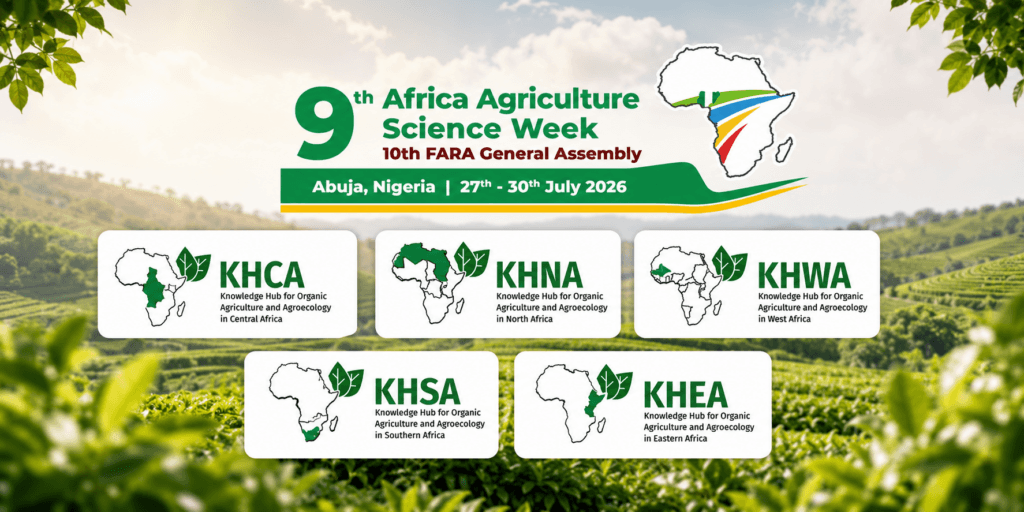
From 27–30 July 2026, Abuja, Nigeria, will host AASW9 and the 10th FARA General Assembly, bringing together researchers, governments, farmers’ organisations, development partners, universities, civil society, youth and private sector actors under the theme: “Innovation and Partnerships for Resilient and Sustainable Agrifood Systems in Africa.”
The theme reflects a growing reality. Africa’s food systems face increasingly complex challenges, including climate change, biodiversity loss, soil degradation, rising food prices, declining agricultural investment and changing consumer demands.
Addressing these challenges requires solutions that are evidence-based, locally relevant and developed through collaboration. No single institution can deliver these solutions alone. Stronger connections between science, policy and practice are essential.
It is within this context that KCOA’s continental knowledge network plays an important role.
The KCOA Difference: Five Regional Hubs, One Shared Vision
KCOA was designed not as a single institution, but as a continental knowledge network that connects actors and experiences across Africa.
Funded by the German Federal Ministry for Economic Cooperation and Development (BMZ) and implemented by GIZ, KCOA strengthens knowledge management, capacity development and information exchange on organic agriculture and agroecology through five regional Knowledge Hubs:
- Knowledge Hub for Eastern Africa (KHEA)
- Knowledge Hub for Central Africa (KHCA)
- Knowledge Hub for Southern Africa (KHSA)
- Knowledge Hub for Northern Africa (KHNA)
- Knowledge Hub for Western Africa (KHWA)
Each hub responds to the realities and priorities of its region while contributing to a shared continental vision.
Through this network, KCOA works to identify, document, package, validate and disseminate knowledge and innovations on organic agriculture and agroecology. The approach helps farmers, extension professionals, researchers, entrepreneurs and policymakers access practical and evidence-based solutions that can be adapted to different contexts.
From Knowledge to Action
KCOA’s work extends beyond convening conversations. Across its five regional Knowledge Hubs, knowledge is identified, documented, packaged and shared through a growing range of resources that support farmers, extension professionals, researchers, policymakers and other actors working to advance agroecology and ecological organic agriculture.
These include technical resources, training materials, case studies, success stories, policy resources, research documentation and other practical learning materials that help translate evidence and experience into action.
For an overview of the practical resources available through the KCOA knowledge ecosystem, explore our feature on; https://kcoa-africa.org/practical-resources-for-organic-farming-agroecology/

Knowledge becomes more powerful when it is translated into practical solutions that farmers can test, adapt and apply in their own contexts. Access some KPs here; KCOA Knowledge Database – KCOA
KCOA at AASW9: Turning Knowledge into Action
At AASW9, all five KCOA Knowledge Hubs will be represented, creating an opportunity for experiences from Eastern, Central, Southern, Northern and Western Africa to come together.
KCOA will collaborate with leading continental and international partners, including FARA, FiBL, RUFORUM, the African Union, the European Commission Joint Research Centre (JRC), EOA-I, and national and regional research and innovation networks.
Together, partners will engage in a series of sessions designed to strengthen the science-policy-practice interface for agroecology, including:
- Side event on Regional Multi-Actor Research Networks (RMRNs)
- Side event on farmer-centred research and innovation
- Parallel session on agroecology and ecological organic agriculture
- Joint exhibition showcasing research, innovations, knowledge products and practical solutions
These engagements are designed to complement one another.
The side events will create opportunities to strengthen collaboration, showcase research, support emerging researchers and innovators, and improve knowledge exchange across regions.
The parallel session will explore how agroecology and ecological organic agriculture can be scaled through stronger links between science, policy and practice, bringing together researchers, policymakers, private sector actors, youth representatives, farmers and development organisations.
The joint exhibition will provide an opportunity for partners to demonstrate how research and knowledge are already being translated into innovations and practical solutions that contribute to improved livelihoods and more resilient food systems.
Together, these engagements tell a bigger story: one where collaboration is not simply an aspiration, but a working model for advancing Africa’s agrifood transformation.
Why Five Regional Knowledge Hubs Matter
Africa’s agricultural realities are diverse.
A soil health innovation successfully tested in Eastern Africa may inspire adaptation in West Africa. A participatory extension model developed in Southern Africa may strengthen advisory services elsewhere. A policy dialogue initiated in North Africa may offer lessons for decision-makers across the continent.
The agroecological realities of Nigeria differ from those of Kenya, just as the challenges facing farmers in Senegal are not identical to those in Madagascar.
Yet across these diverse contexts, common lessons continue to emerge: healthy soils matter, biodiversity strengthens resilience, farmer knowledge is essential, and evidence must inform policy and practice.
Innovation works best when it is developed with farmers rather than for farmers.
By bringing together representatives from all five KCOA Knowledge Hubs, AASW9 creates an opportunity to compare experiences, identify shared challenges and accelerate learning across regions.
What works in one region can inspire adaptation in another. Research conducted in one country can contribute to policy discussions elsewhere. A successful extension model developed by one Knowledge Hub can strengthen knowledge delivery across the continent.
This is how continental knowledge systems grow, not through duplication, but through collaboration, adaptation and shared learning.
Knowledge That Connects People and Places
Beyond the discussions and exhibitions, AASW9 offers something equally valuable, the opportunity to strengthen relationships that continue long after the event.
For KCOA, every new connection between researchers, extension professionals, policymakers, farmers, entrepreneurs and development partners strengthens the continental knowledge network that the initiative was established to build.
When researchers collaborate across borders, extension professionals have access to relevant knowledge, policymakers draw on evidence, and farmers become equal partners in innovation, knowledge becomes a powerful driver of transformation.
The impact of this approach can be seen not only in the knowledge products generated, but also in the people and communities using that knowledge to improve agricultural practices, strengthen livelihoods and build resilience.
Building Africa’s Agrifood Future Together
Africa’s agrifood transformation will not be achieved by one project, one organisation or one technology. It will be built through stronger partnerships, better knowledge exchange and a shared commitment to learning from one another.
As KCOA and its five Knowledge Hubs join partners at AASW9, they do so with a common purpose: to ensure that knowledge does not remain on paper, but reaches the people who need it most.
We invite researchers, extension professionals, farmers, policymakers, development partners, youth, private sector actors and all stakeholders committed to resilient and sustainable agrifood systems to join us physically and virtually as we explore how knowledge, partnerships and innovation can help shape the future of agriculture in Africa.
Explore KCOA’s Knowledge Resources
Discover knowledge products, farmer experiences, innovations, research and practical solutions from across Africa.
Across the five Knowledge Hubs, this work is reflected in a growing portfolio of knowledge products, including farmer guides, technical briefs, case studies, success stories, policy resources, training materials, videos and other practical resources that help translate evidence into action. Some examples of these knowledge products include:
- Farmer training manuals and guides ; kcoa-africa.org/wp-content/uploads/2025/10/giz2023-en-training-manual-household-based-pond-aquaculture-cambodia-2.pdf
- Agroecology case studies ; ilias-tbrika-reviewed-2.pdf
- Policy briefs ; Agroecological_Ecological_Multi-Ministerial_2024_Policy_Briefing_Pack-2.pdf
Five Knowledge Hubs. One continental network. One shared commitment to advancing agroecology and ecological organic agriculture across Africa.

Author: Hepzibah Ebe
Experienced and results-driven Communications expert with over nine (9) years of expertise in developing and executing effective communication strategies, including more than two (2) years of specialization in agroecology