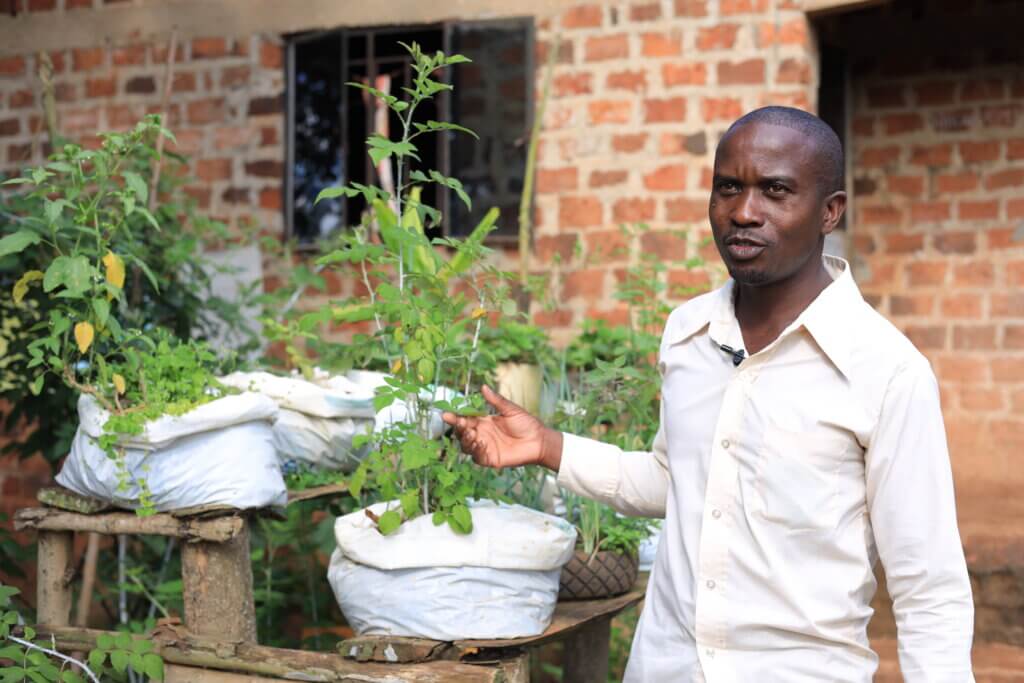
For Alex Kasaja, agriculture has been both a livelihood and a journey of transformation. Once engaged in the sale of synthetic agrochemicals, Alex’s life took an unexpected turn when prolonged exposure to chemicals affected his health. Today, he is an advocate for organic agriculture, a producer and distributor of organic farm inputs, and a KHEA-trained Multiplier who has empowered more than twelve farmer groups to embrace agroecological practices.
His story demonstrates how knowledge, combined with determination and community engagement, can transform personal challenges into sustainable opportunities that benefit entire farming communities.
A Health Challenge that Changed Everything
Alex Kasaja joined PELUM Uganda as an individual member shortly after the COVID-19 pandemic. Before then, he worked in his family’s agrochemical farm supply business, selling synthetic pesticides and other agricultural chemicals.
However, years of handling agrochemicals often without adequate protective equipment began taking a toll on his health.
“Over time, I developed ulcers and respiratory complications. When I visited an ENT specialist, the diagnosis suggested that I had likely been exposed to agrochemicals, dust, or smoke. Deep down, I knew this was true because I had spent years handling agrochemicals.”
— Alex Kasaja
The experience became a turning point, prompting him to seek safer and more sustainable alternatives for both farmers and the environment.
Discovering Agroecology through KHEA
During this period, Alex was introduced to PELUM Uganda through Peter Setenda of the Centre for Integrated Development.
At the time, PELUM Uganda was implementing the KCOA-KHEA Project, training multipliers to promote organic agriculture and agroecology.
Alex enrolled as an individual member of PELUM Uganda and was selected to attend the KHEA Multiplier Training hosted by St. Jude Family Projects in Masaka.
The training equipped him with practical skills in:
- Organic farming principles
- Production of organic fertilizers
- Preparation of botanical pesticides
- Organic farm input production
- Sustainable soil fertility management
- Agroecological farming practices
Following the training, Alex immediately began producing his own organic, chemical-free farm inputs.
Sharing Knowledge with Farming Communities
Rather than keeping the knowledge to himself, Alex embraced his role as a multiplier.
He began organizing and training farmer groups across Nakifuma County, supporting communities in almost every sub-county.

Today, he works with more than twelve farmer groups, helping them produce their own organic fertilizers and pesticides while adopting sustainable farming practices.
Some of the farmer groups include:
- Osobola Women’s Group – Naggalama
- Balimi Balunzi – Wangeyo (now a Participatory Guarantee System (PGS) group)
- Okwata Empola – Nakifuma
- Kiweebwa Youth Agripreneurs
- Kwagalana Lugala Group – Kasawo
- Youth in Agroecology – Nanga
- Zibula Atuudde – Nyenje
These groups now produce and utilize their own organic agricultural inputs, reducing dependence on synthetic chemicals while improving environmental sustainability.
Turning Knowledge into a Sustainable Enterprise
Alex’s academic background in Environmental Studies from Makerere University further strengthened his commitment to environmental conservation and sustainable agriculture.
Inspired by the KHEA training, he specialized in producing and marketing organic fertilizers and botanical pesticides.
Today, he operates a farm supply shop in Nakifuma Trading Centre that exclusively stocks organic agricultural inputs.
What makes the enterprise unique is its circular business model.
Many of the farmer groups Alex trained now produce quality organic farm inputs. Alex purchases these products and supplies them to farmers and farmer groups that have not yet begun producing their own.
This approach has created reliable market opportunities for local producers while expanding farmers’ access to affordable organic inputs.
Promoting Healthier Farming Systems
Through his enterprise, farmers across Nakifuma and neighbouring communities now have easier access to organic farm inputs.
As awareness continues to grow regarding the health and environmental risks associated with synthetic agrochemicals, more farmers are choosing safer and more sustainable alternatives.
For Alex, the enterprise is not only a source of income but also a platform for advancing agroecology.
“I chose this enterprise because, as an individual member of PELUM Uganda, I needed a sustainable source of income that would also enable me to maintain my membership and continue contributing to the agroecology movement. Organic farm inputs have provided that opportunity while offering farmers a practical and environmentally friendly alternative to synthetic agrochemicals.“
— Alex Kasaja
Today, his work continues to generate income, strengthen local enterprises, support fellow farmers, and promote the adoption of organic agriculture throughout the community.
Creating a Multiplier Effect
Alex’s journey illustrates how investing in one individual can create lasting change across many communities.
By sharing the knowledge gained through KHEA, he has enabled numerous farmers to become producers of organic inputs, reduced reliance on synthetic agrochemicals, and strengthened local agroecological enterprises.
His experience highlights the importance of combining capacity building, entrepreneurship, and farmer-to-farmer learning to accelerate the transition towards sustainable food systems.
Impact Statement
Alex’s story demonstrates the multiplier effect of the KHEA project.
”By equipping one farmer with practical agroecological knowledge and skills, the project has catalyzed the training of more than twelve farmer groups, increased access to organic farm inputs, strengthened local enterprises, and accelerated the transition towards sustainable agriculture in Nakifuma and surrounding communities.”
— Alex Kasaja
Knowledge Products
This success story demonstrates how the KHEA Multiplier approach equips individuals with practical skills that are replicated across communities, creating lasting impacts in knowledge sharing, entrepreneurship, environmental conservation, and sustainable agriculture.
Key Agroecological Practices Promoted
- Organic fertilizer production : https://view.officeapps.live.com/op/view.aspx?src=https%3A%2F%2Fkcoa-africa.org%2Fwp-content%2Fuploads%2F2025%2F11%2FOrganic-fertilizer-based-on-kitchen-wastes-and-goat-manure-for-scallions-production-1.pptx&wdOrigin=BROWSELINK
- Botanical pesticide production : https://kcoa-africa.org/wp-content/uploads/2025/10/Ginger_Bush_organic_pesticides-2.pdf
- Participatory Guarantee Systems (PGS) : https://kcoa-africa.org/wp-content/uploads/2025/10/PGS-GUIDE-FOR-SMALL-SCALE-FARMERS-3.pdf
- Sustainable soil fertility management :https://kcoa-africa.org/wp-content/uploads/2025/11/Management-of-soil-fertility-4.pdf
- Community-based agroecology training :https://kcoa-africa.org/wp-content/uploads/2025/10/Guide-trainer-Towards-sustainable-food-systems-1-4.pdf
Alex Kasaja’s journey demonstrates how investing in people can create lasting change. What began as a personal search for healthier and safer farming alternatives has grown into a thriving organic farm input enterprise that is improving livelihoods, strengthening local markets, and supporting the adoption of agroecology across Nakifuma and beyond.
Through the Knowledge Hub for Organic Agriculture and Agroecology in Eastern Africa (KHEA) cooridnated by Biovision Africa Trust in close collaboration with PELUM Uganda, Alex acquired practical knowledge that not only transformed his own career but also enabled him to empower fellow farmers with sustainable solutions. His story illustrates the multiplier effect of capacity building where one trained individual becomes a catalyst for knowledge sharing, entrepreneurship, and community-wide adoption of organic farming practices.
As more farmers embrace agroecology, stories like Alex’s demonstrate the power of knowledge, innovation, and collaboration in building resilient food systems and a healthier future for both people and the environment.
Disclaimer:
– To learn about the KCOA Project: https://kcoa-africa.org/
– To learn about the KHEA Project: https://khea-africa.org/
– For more details on this article, please reach out to; ezrakalule@pelumuganda.org OR pmagino@biovisionafrica.org
– See the license statement of all KCOA content: https://kcoa-africa.org/license-statement/ , which applies to all content from hubs implementing the KCOA project.