The Invisible Giants Feeding a Continent
When you think of feeding Africa’s 1.4 billion people, what comes to mind? Massive industrial farms with endless rows of crops? High-tech machinery working in vast landscapes? The reality might surprise you.
The truth is, the backbone of Africa’s food system is not found in large agribusiness. It is in the hands of millions of farmers you have probably never heard of, smallholder farmers who cultivate plots smaller than two hectares yet produce up to 80% of the food consumed across the continent.
Unfortunately, often times, these agricultural heroes are often overlooked, underfunded and undervalued in discussions about food security farming.
The Crisis Hiding in Plain Sight
While smallholder farming in Africa represents the foundation of our food systems, these farmers face mounting challenges that threaten not just their livelihoods, but our collective food security:
The Scale of the Challenge:
- Over 70% of Africa’s rural population depends on smallholder agriculture
- Climate change is hitting small farms hardest
- Limited access to modern farming knowledge and techniques
- Lack of financial resources for sustainable farming practices
- Increasing pressure to feed growing urban populations
What Happens When We Ignore Smallholder Farmers:
- Food insecurity increases across communities
- Rural poverty deepens
- Young people abandon farming for cities
- Traditional agricultural knowledge disappears
- Environmental degradation accelerates
The consequence? A continent rich in agricultural potential struggles with hunger and food insecurity, not because we lack the resources, but because we are not empowering the very people who grow our food.
The Game-Changing Solution: Empowered Smallholder Farmers
When smallholder farmers are equipped with knowledge of agroecological and organic systems, they become powerhouses of sustainable food production. They are not just growing crops but building resilient food systems that can feed communities while healing the land.
Why Smallholder Farmers Are the Real Most Valuable Persons (MVPS)
1. Local Food Security Champions: Smallholder farmers grow diverse crops that match local dietary needs and preferences. Unlike large monoculture operations, they produce a variety of foods that make up traditional African diets, from indigenous vegetables to drought-tolerant grains.
2. Climate-Smart Agriculture Pioneers: When empowered with agroecology for small farms, these farmers become environmental stewards who:
- Preserve soil health through traditional and modern techniques
- Maintain crop diversity that is crucial for climate resilience
- Use water resources more efficiently than industrial farms
- Capture carbon in healthy soils
3. Economic Multipliers: Money spent with smallholder farmers stays in local communities, creating a ripple effect that strengthens entire regions. Every dollar earned by a smallholder farmer generates additional economic activity in rural areas.
The Power of Knowledge: Transforming Small Farms
The magic happens when smallholder farmers gain access to:
Regenerative Farming Techniques:
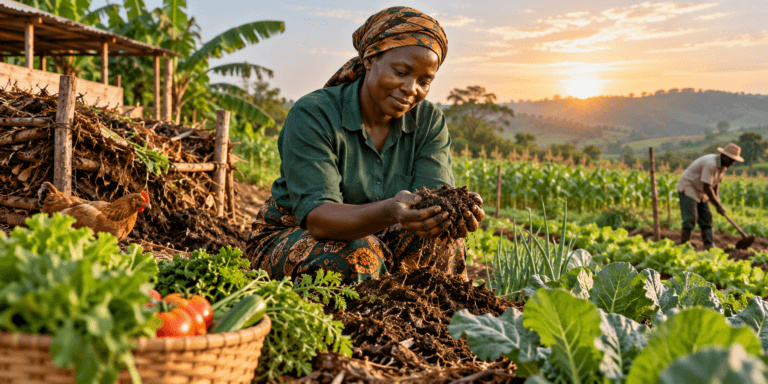
- Composting and natural fertilisation methods
- Crop rotation and intercropping strategies
- Water conservation and soil building practices
- Integrated pest management systems
Modern Agroecological Approaches:
- Climate-adapted seed varieties
- Sustainable livestock integration
- Market linkage strategies
- Financial literacy and farm business management
Success Stories: Small Farms, Big Impact
Across Africa, smallholder farmers armed with regenerative knowledge are achieving remarkable results:
- Doubling crop yields without expensive inputs
- Building soil health that makes farms more resilient
- Creating surplus production that strengthens local markets
- Developing successful farming enterprises that keep youth in agriculture
The Path Forward: Investing in Africa’s Food Security
The solution to Africa’s food security does not require massive infrastructure investments or high-tech solutions. It requires something simpler yet more powerful: investing in the knowledge and capacity of smallholder farmers.
What This Means for Africa’s Future:
- Stronger local food systems that can weather global supply chain disruptions
- Rural communities that thrive economically
- Environmental restoration through regenerative farming practices
- Food sovereignty that reduces dependence on imports
How We Can Support This Vision:
- Prioritise farmer education and training programs
- Support research into climate-adapted farming techniques
- Create better market access for smallholder farmers
- Invest in rural infrastructure that connects farmers to opportunities
Ready to become an informed advocate for smallholder farming in Africa? Start by understanding the terminology that shapes agricultural development discussions.
Download the Food and Farming System Jargon Dictionary from the link below:

Author: Rabecca Mwila
Rabecca Mwila is a passionate advocate for sustainable agriculture and environmental stewardship. With a background in climate change and communications, she has spent years telling the untold stories of the realities of climate change, environmental and climate injustices and how they affect vulnerable communities in Africa and beyond