When Your Field Turns to Dust
You stand at the edge of your maize field after a heavy summer storm, hoping to see green shoots pushing through dark, moist soil. The reality is gullies, deep scars carved by rushing water. Your topsoil, the very thing that feeds your family, has washed down the slope and into the river.
Across Southern Africa, more than 45% of agricultural land is already severely degraded by erosion and poor water management. Every rainy season, tons of precious topsoil rich in nutrients and organic matter is washed away.
The solution lies in soil and water, and how to keep them working for you.
This article explains what soil and water conservation means, why your farm’s future depends on it and how you can start protecting both today with nothing more than a few sticks, some grass and a little knowledge.
Why Your Farm Is Bleeding to Death
When rain falls on bare, compacted soil, it does not soak in. It pools, then runs downhill, gathering speed and power. As it flows, it picks up loose soil particles first the fine, nutrient-rich clay and organic matter, then heavier sand. Before you know it, your field has a gully that grows deeper every season.
What you lose:
- Nutrients: Topsoil contains 80-90% of your soil’s fertility. When it washes away, so does your next harvest.
- Water: Instead of soaking into the ground to feed your crops during dry spells, rainwater becomes destructive runoff.
- Money: Every kilogram of lost topsoil represents years of composting, mulching and hard work.
The signs are everywhere:
- Brown rivers after rain (that’s your soil floating away).
- Thin, pale crops even after fertilising.
- Hard, cracked ground that repels water like concrete.
- Visible gullies or “dongas” cutting through your land.
The problem is not the rain but your soil which has lost its sponge, its ability to absorb and hold water.
What Happens If You Do Nothing?
With your top soil thinner, when the first storm hits, half your seeds wash out of the ground.
By mid-season, your maize is stunted, yellow and wilting between rains because the soil can noty hold moisture.
The long-term cost:
- Lower yields every year – as topsoil shrinks, so do your harvests.
- More expensive inputs – you buy more fertiliser, but it washes away.
- Loss of farmland – deep gullies can make fields unplantable.
- Hunger and debt – when the land fails, families suffer.
Unfortunately, this is the reality for thousands of farmers who have watched their inheritance turn to dust.
However, there are affordable methods that can effectively reduce soil erosion.
Your Soil and Water Conservation Toolkit
Soil and water conservation (SWC) is simply this: keep soil in place and keep water in the soil.
The KATC Soil and Water Conservation knowledge product gives you three powerful principles and three practical techniques. Here’s how to use them.
The 3 Unbreakable Principles of SWC
| Principle | What It Means | Why It Works |
| Disturb the soil as little as possible | Stop ploughing every inch. Use minimum tillage. | Undisturbed soil has structure – tiny channels and pores that allow water to seep in. |
| Cover the soil as much as possible | Leave crop residues, plant cover crops and use mulch. | Cover protects against rain impact, keeps soil cool and stops evaporation. |
| Mix and rotate crops | Do not plant the same crop in the same field every year. | Different roots open different channels; rotation breaks pest cycles. |
3 Low-Cost Techniques to Stop Erosion on Slopes
If your land is flat, the principles above may be enough, but if your farm is on a slope, you need contour practices.
What are contours?
Imagine a line across your slope where every point is the same height above sea level. That is a contour line. Water running down the slope will hit anything you build along that line and slow down, sink in, or drop its soil.
How to find contour lines (the A-Frame method)
Build an A-frame from three poles (two 2m, one 1.5m). Tie a string with a stone to the top. When the string hangs exactly over the middle mark on the crossbar, the two legs are on the same level as the contour.
(See the KATC Soil and Water Conservation Poster for step-by-step diagrams.)
Once you’ve marked your contour lines, choose your weapon:
| Technique | How to Build | Best For |
| Grass strips | Plant tuft grasses (vetiver, Napier, guinea) in rows along the contour. | Gentle slopes also provide animal fodder. |
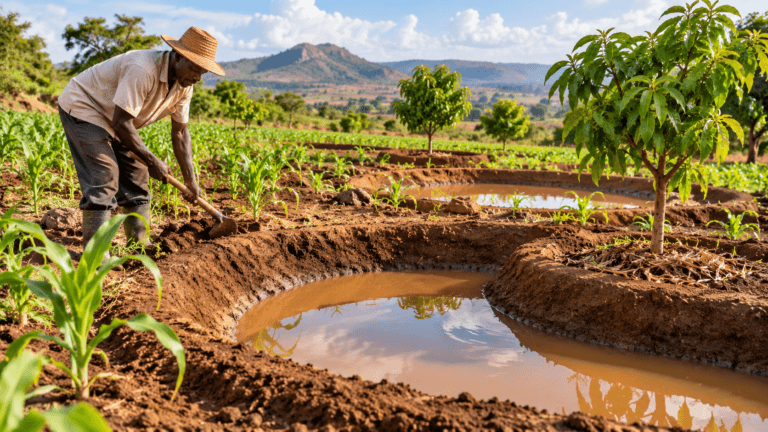
| Contour ditch & ridge | Dig a ditch 30cm deep, 50cm wide along the contour. Use the soil to make a ridge on the downhill side. Plant strong-rooted plants on the ridge. | Moderate slopes; capture runoff and store water. |
| Stone lines | Pile stones along the contour – bigger stones downhill, smaller uphill. | Rocky areas slow water and trap sediment. |
Which one should you choose?
If you have grass, use grass strips (free and fast). If you have stones, use stone lines (permanent). If you have labour, dig contour ditches (most effective). You can also combine them, for example, plant grass on a stone line.
Your First Steps – Starting Tomorrow
You don’t need to wait for next season. You can start saving your soil today.
Step 1:
Walk your fields after a rain. Where do you see water pooling or running off? Where are the gullies? Take a stick and scratch the soil surface. Is it hard and cracked? That’s your problem zone.
Step 2:
Build an A-frame. Use old poles or cut straight branches. Follow the poster’s instructions. Find your first contour line on the slope that erodes the worst.
Step 3 (Before next rain):
Dig one contour ditch or plant one grass strip along that line. Just one. See how it works. Take photos before and after the next storm.
Step 4:
Start covering your soil. Leave maize stalks standing. Mulch between rows with grass. Plant a cover crop like cowpeas after harvest.
Download the KATC Soil and Water Conservation Poster for more information.

Author: Rabecca Mwila
Rabecca Mwila is a passionate advocate for sustainable agriculture and environmental stewardship. With a background in climate change and communications, she has spent years telling the untold stories of the realities of climate change, environmental and climate injustices and how they affect vulnerable communities in Africa and beyond