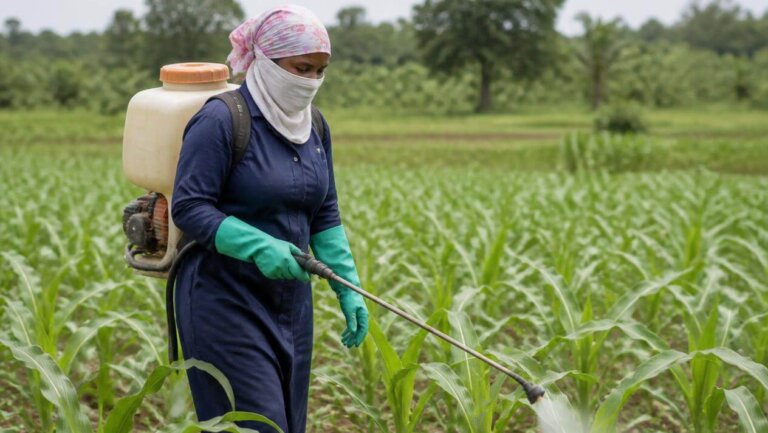
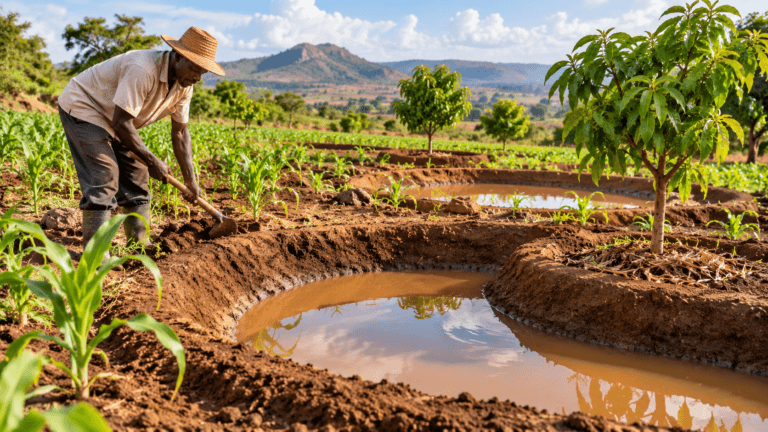
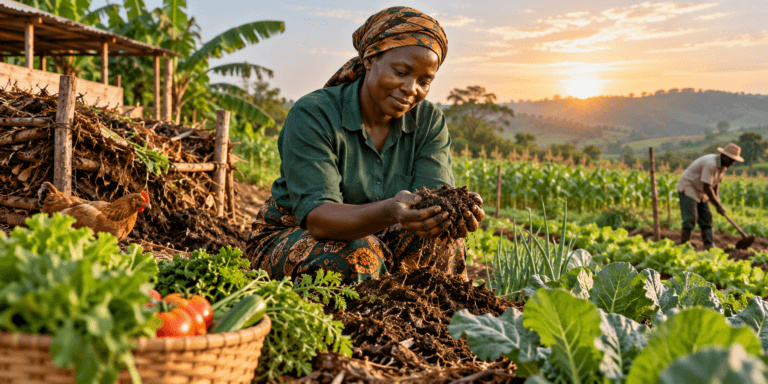
Caption: Julius Echodu on his agroecological farm in Uganda’s Teso sub-region
In the heart of Uganda’s Teso sub-region, Julius Echodu is proving that agroecology is more than a farming approach, it is a pathway to resilience, innovation, and community transformation.
As a trained KHEA Multiplier under the KCOA–KHEA Project with coordination from PELUM Uganda, Julius has turned the knowledge gained through agroecology trainings into practical solutions that are improving livelihoods, restoring ecosystems, and inspiring farmers across Eastern Uganda.
During the KHEA Support Supervision Visit in Uganda (18–22 May 2026), the KHEA team visited Julius to witness firsthand the remarkable progress and innovations emerging from his agroecological work.
Turning Knowledge into Community Solutions
What began as training participation has evolved into a thriving agroecological enterprise and knowledge-sharing hub. Julius has developed and tested several innovative bio-inputs using locally available plants and shrubs found within his environment.
Among his innovations are:
- A bio-animate immune booster
- Bio pesticides
- Bio fungicides
- Locally adapted agroecological farming solutions for crop resilience
One of his notable achievements is the development and promotion of a resilient tomato variety that thrives without the need for chemical spraying. He also propagates indigenous maize seed varieties each season and supplies them to farmers across the Teso region, helping preserve local biodiversity while strengthening food security.
Speaking during the support supervision visit, Julius guided the KHEA team through the different plants and shrubs that serve as the foundation for his bio-input innovations, demonstrating how indigenous knowledge and agroecology can work hand in hand to create sustainable farming systems.
“Agroecology has helped me innovate using local resources while supporting farmers and protecting the environment.” — Julius Echodu
Related Knowledge Products
- Agroecological Bio-input Production Guide ; Organic-liquid-pesticide-based-on-pesticidal-plants-marigolds-papaya-leaves-and-vernonia-leaves-for-cabbage-pests-control.pptx
- Sustainable Pest and Disease Management Manual; https://kcoa-africa.org/wp-content/uploads/2025/05/Control-of-pests-and-diseases-with-Sulphur.docx
- [Insert Link] Indigenous Seed Preservation Resource; https://kcoa-africa.org/wp-content/uploads/2025/05/Organic-seed-protection-KP.docx
Supporting Women and Local Enterprises
Beyond production, Julius is also contributing to community empowerment through value addition initiatives. Using the skills acquired through KHEA trainings, he supports women-led groups in processing cereals, soybeans, and nuts into value-added products that can generate additional income and improve household livelihoods.
His efforts highlight the role agroecology can play not only in sustainable food production but also in strengthening local economies and community resilience.

Related Knowledge Products
- Value Addition and Agro-processing Guide; Sweet potato flour
- Women and Agroecology Toolkit ; kcoa-africa.org/wp-content/uploads/2025/08/Contribution-of-women-in-agroecology.pdf
Integrated Agroecology in Practice
Julius practices diversified farming systems that reflect the principles of agroecology. On his farm, crop production is integrated with livestock keeping, fish farming, and beekeeping to create a balanced and self-sustaining ecosystem.
His farm includes:
- Cattle, goats, and poultry
- Fish ponds
- Beekeeping enterprises
- Agroecological production of sim sim, millet, cassava, beans, maize, tomatoes, and other crops
This integrated approach enhances soil health, improves farm resilience, reduces dependency on external inputs, and creates multiple income streams for the household.
 Caption: Julius practices integrated agroecology through crop diversification, livestock keeping, fish farming, and beekeeping.
Related Knowledge Products
- Integrated Farming Systems Manual ; Food-and-Farming-System-Jargon-Dictionary.pdf
- Soil Health and Agroecology Resource ; kcoa-africa.org/wp-content/uploads/2024/05/Soil-Health.pdf
- Sustainable Beekeeping Guide ; Abeille-Revue-N°37.pdf
- Diversified Farming Systems Toolkit
Beyond his farm, Julius is also an active agroecology advocate and consultant within the Teso sub-region and beyond. Through regular radio talk shows on stations including Joshua FM, Voice of Serere, Voice of Teso, Dokolo FM, Top Radio, and Delta FM, he shares practical agroecological knowledge with farming communities across the region.
His growing influence demonstrates the power of farmer-to-farmer learning and the importance of local champions in scaling agroecological transformation.
 Caption: Through radio talk shows and farmer outreach, Julius continues to promote agroecological practices across the Teso sub-region.
Strengthening Farmer-Led Innovation
The KHEA Support Supervision Visit focused on:
📊 M&E support
📢 Field documentation
🤝 Partner strengthening
Julius’ journey stands as a strong example of how targeted knowledge sharing and farmer empowerment can lead to locally driven innovations with lasting impact.
Implemented in Eastern Africa by, the KCOA–KHEA Project continues to support farmers, multipliers, and institutions in promoting agroecological transitions across the region. The initiative is funded by through.
Julius Echodu’s story is a reminder that when farmers are equipped with knowledge, they become innovators, educators, and changemakers within their communities.


Disclaimer:
– To learn about the KCOA Project: https://kcoa-africa.org/
– To learn about the KHEA Project: https://khea-africa.org/
– For more details on this article, please reach out to pmagino@biovisionafrica.org
– See the license statement of all KCOA content: https://kcoa-africa.org/license-statement/ , which applies to all content from hubs implementing the KCOA project.

Author: Pamella Magino
Ms. Magino Pamella joined PELUM Uganda on 1st Oct 2021 as Communications Officer for the KCOA-KHEA project. With 9+ years in Communications and Marketing, she specializes in Public Relations, Business Development, and Marketing. Pamella holds a Bachelor’s in Mass Communication (Public Relations) and is a Certified Member of PRAU. She has worked with organizations like The Nile Basin Initiative and Victoria University Kampala, crafting strategies that drive positive change