On a small piece of land in Thika, Kenya, what once appeared to be an unlikely location for farming transformation has today become a thriving hub for agroecological learning, innovation, and community empowerment.
The Grow Biointensive Agriculture Center of Kenya (G-BiACK), led by Samuel Nderitu, stands today as a Centre of Excellence under the KCOA-KHEA Project, impacting farmers, youth, women, and community groups through sustainable agriculture and capacity building initiatives.
Following the recent KHEA Monitoring and Support Supervision visit to PELUM Kenya and G-BiACK under the KCOA Centre of Excellence framework by Biovision Africa Trust and PELUM Kenya representatives, the G-BiACK Centre was reaffirmed as a key agroecological learning hub demonstrating strong progress in training delivery, farmer outreach, and knowledge dissemination. The visit highlighted the centre’s continued role in strengthening farmer-led innovation, multiplier training, and practical application of agroecological practices at community level.

Samuel’s agroecology journey was significantly strengthened in 2022 after receiving training support through IFOAM Organics International – an International Partner on the KCOA Project as a KCOA Master Trainer under PELUM Kenya. The training enhanced his knowledge in agroecological systems, regenerative farming, soil restoration, farmer-centered learning, and sustainable food systems. Armed with practical skills and renewed motivation, Samuel returned to his community determined to turn knowledge into action.
What makes G-BiACK unique is not only the training it offers, but the remarkable transformation of the land itself.
 The centre sits on approximately two acres of land that was originally characterized by heavy clay soil and difficult terrain. Establishing a productive agroecological demonstration farm under such conditions was not easy. It required years of experimentation, resilience, and commitment to ecological farming principles.
Through continuous application of sustainable practices, the centre gradually restored soil health and transformed the once challenging land into a productive agroecological learning site.
Today, G-BiACK showcases several innovative agroecological technologies and practices, including:
- Double-dug biointensive beds for improved soil aeration and water retention
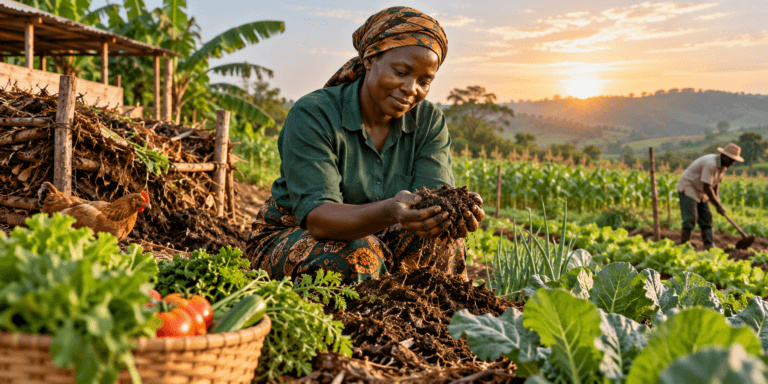
- Bokashi and compost production for organic soil fertility management
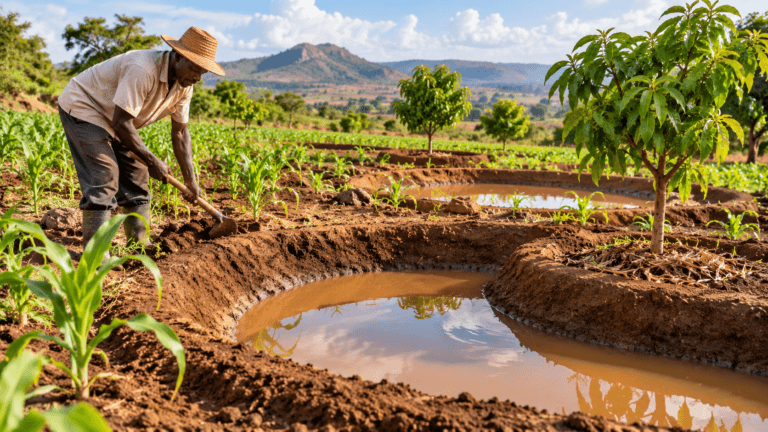
- Water harvesting and efficient irrigation systems
- Mulching and cover cropping to conserve soil moisture
- Indigenous seed saving and seed banking
- Integrated crop and livestock systems
- Agroforestry and tree integration
- Vermiculture and organic waste recycling
- Kitchen and nutrition gardens for household food security
- Climate-smart farming and regenerative agriculture practices
These technologies have not only restored the soil but also improved productivity, biodiversity, and resilience to climate change.
The centre has now become a practical learning hub where farmers can see agroecology in action. Through trainings, mentorship, demonstrations, and farmer exchanges, Samuel and his team continue to equip communities with low-cost and sustainable farming solutions.

Through the KCOA-KHEA project, Samuel Nderitu has also played a key role in training KHEA multipliers who continue to cascade agroecological knowledge and practices within their respective communities. By strengthening the capacity of trainers, extension actors, youth leaders, and farmer champions, the centre has expanded the reach and impact of agroecological learning beyond the demonstration site itself.
In photo; KHEA Multiplier, Collins Chibole showcases a bountiful harvest that celebrates tradition and diversity? Indigenous heirloom seed varieties offer resilience, rich nutrition, cultural heritage, and sustainable farming solutions for future generations at GBIACK
 KHEA Multiplier, Collins Chibole taking farmers on a farm tour at the Centre of Excellence
The impact has extended beyond training alone.

Through the sale of vegetables, seedlings, compost, seeds, and value-added farm products, the centre has created income-generating opportunities that support livelihoods while demonstrating the economic viability of agroecology. Farmers trained at the centre are increasingly adopting similar approaches to improve household incomes, nutrition, and food security.
G-BiACK has also become a source of inspiration for youth and women seeking practical solutions to unemployment, land degradation, and rising farming costs. By maximizing productivity on a small piece of land, the centre demonstrates that agroecology can provide both environmental and economic benefits.

As a KCOA-KHEA Centre of Excellence, G-BiACK continues to serve as a knowledge-sharing platform where communities access practical skills, innovations, and learning resources that contribute to sustainable food systems.

In photo; BVAT and PELUM Kenya , key partners on the KCOA Project engage in a practical learning session on agroecological farming approaches, exploring sustainable practices such as composting, companion planting, and carbon farming witghSamuel Nderitu
As a KCOA-KHEA Centre of Excellence, G-BiACK continues to serve as a knowledge-sharing platform where communities access practical skills, innovations, and learning resources that contribute to sustainable food systems.
In addition to on-farm demonstrations and farmer trainings, Samuel Nderitu has also contributed significantly to knowledge generation under the KCOA-KHEA project. He has authored and supported the development of several Knowledge Products documenting practical agroecological innovations, sustainable farming technologies, soil fertility management practices, and farmer-led solutions aimed at strengthening learning and replication across communities.
Some of the Knowledge Products developed bythe Master Trainer include:
- https://kcoa-africa.org/wp-content/uploads/2024/05/KP-5-Goat-business-is-profitable.pdf
- https://kcoa-africa.org/wp-content/uploads/2024/05/KP-4-HEALTH-BENEFITS-OF-HERBS-1.pdf
- https://kcoa-africa.org/wp-content/uploads/2024/05/KP-3-VERMICULTURE.pdf
- https://kcoa-africa.org/wp-content/uploads/2024/05/KP-2-THE-8-PRINCIPLES-OF-GROW-BIOINTENSIVE.pdf
- https://view.officeapps.live.com/op/view.aspx?src=https%3A%2F%2Fkcoa-africa.org%2Fwp-content%2Fuploads%2F2024%2F08%2FKP-1-THE-GROW-BIOINTENSIVE-AGRICULTURE-TECHNIQUES1.docx&wdOrigin=BROWSELINK
These resources continue to support farmers, practitioners, and institutions seeking practical, locally adapted agroecological solutions.
📘 Some of the Knowledge Products and learning resources include:
- Soil fertility and composting guides : https://kcoa-africa.org/wp-content/uploads/2025/09/Management-of-soil-fertility.pdf ,, https://kcoa-africa.org/wp-content/uploads/2024/05/BOOK3-1.pdf ,, https://kcoa-africa.org/wp-content/uploads/2024/05/Soil-Health.pdf ,,
- Agroecology training manuals : The 10 elements of agroecology
- Indigenous seed preservation resources : https://view.officeapps.live.com/op/view.aspx?src=https%3A%2F%2Fkcoa-africa.org%2Fwp-content%2Fuploads%2F2025%2F05%2FOrganic-seed-protection-KP.docx&wdOrigin=BROWSELINK
- Water harvesting and climate-smart agriculture guides; Underground-water-harvesting-technologies.pptx
- Farmer business and value addition resources; Sweet potato flour
- Organic pest and disease management materials; Tephrosia-Biopesticide-1.pdf
Samuel Nderitu’s journey is a powerful reminder that capacity building can spark transformation far beyond the classroom. What began as training has grown into a living example of resilience, innovation, and community empowerment.
Through dedication, continuous learning, and agroecological innovation, G-BiACK continues to transform lives — one farmer, one household, and one harvest at a time.
#KCOA #KHEA #Agroecology #Gbiack #FarmerEmpowerment #SoilHealth #ClimateSmartAgriculture #KnowledgeSharing #SustainableFoodSystems #BiointensiveFarming


Disclaimer:
– To learn about the KCOA Project: https://kcoa-africa.org/
– To learn about the KHEA Project: https://khea-africa.org/
– For more details on this article, please reach out to pmagino@biovisionafrica.org
– See the license statement of all KCOA content: https://kcoa-africa.org/license-statement/ , which applies to all content from hubs implementing the KCOA project.

Author: Pamella Magino
Ms. Magino Pamella joined PELUM Uganda on 1st Oct 2021 as Communications Officer for the KCOA-KHEA project. With 9+ years in Communications and Marketing, she specializes in Public Relations, Business Development, and Marketing. Pamella holds a Bachelor’s in Mass Communication (Public Relations) and is a Certified Member of PRAU. She has worked with organizations like The Nile Basin Initiative and Victoria University Kampala, crafting strategies that drive positive change